


My son just turned 14 and a local ice cream shop wants to hire him for weekday evenings and weekends. The manager suggested shifts until 8 p.m. on school nights. How many hours can a 14- or 15-year-old legally work, and do the rules change in the summer?
How many hours can a 14- or 15-year-old work?
Concerns & risks
Your 14-year-old has a job offer with school-night shifts until 8 p.m.
| Task | Federal rule |
|---|---|
| Baking | Not allowed |
| Most power machinery | Not allowed |
| Freezers and meat coolers | Not allowed (with limited exceptions) |
| Cooking | Limited conditions only |
| Ladders and scaffolds | Not allowed |
| Cashier, shelving | Generally allowed |

Causes & evidence
The Department of Labor's YouthRules program explains that under the Fair Labor Standards Act, 14- and 15-year-olds in non-agricultural jobs may work outside school hours only. Limits are 3 hours on a school day, including Friday; 18 hours in a school week; 8 hours on a non-school day; and 40 hours in a non-school week. They may work only between 7 a.m. and 7 p.m., except from June 1 through Labor Day, when evening hours extend to 9 p.m. Whether a week counts as a school week is based on the local public school district where the minor lives. Federal rules also restrict hazardous tasks; for example, 14- and 15-year-olds generally can't bake, operate most power-driven machinery or work in freezers and meat coolers. If state law is stricter, the stricter rule applies. Many states require work permits for minors.
Who this applies to: non-agricultural jobs. 16- and 17-year-olds have no federal hour limits but are barred from hazardous jobs. Family businesses and some jobs like newspaper delivery have exceptions; states may be stricter.

An 8 p.m. finish on a school night breaks the federal 7 p.m. limit outside the summer window, no matter how short the shift.
What to do


| Limit | Federal rule |
|---|---|
| School day | Up to 3 hours |
| School week | Up to 18 hours |
| Non-school day | Up to 8 hours |
| Non-school week | Up to 40 hours |
| Time of day | 7 a.m. to 7 p.m. |
| June 1 to Labor Day | Until 9 p.m. |
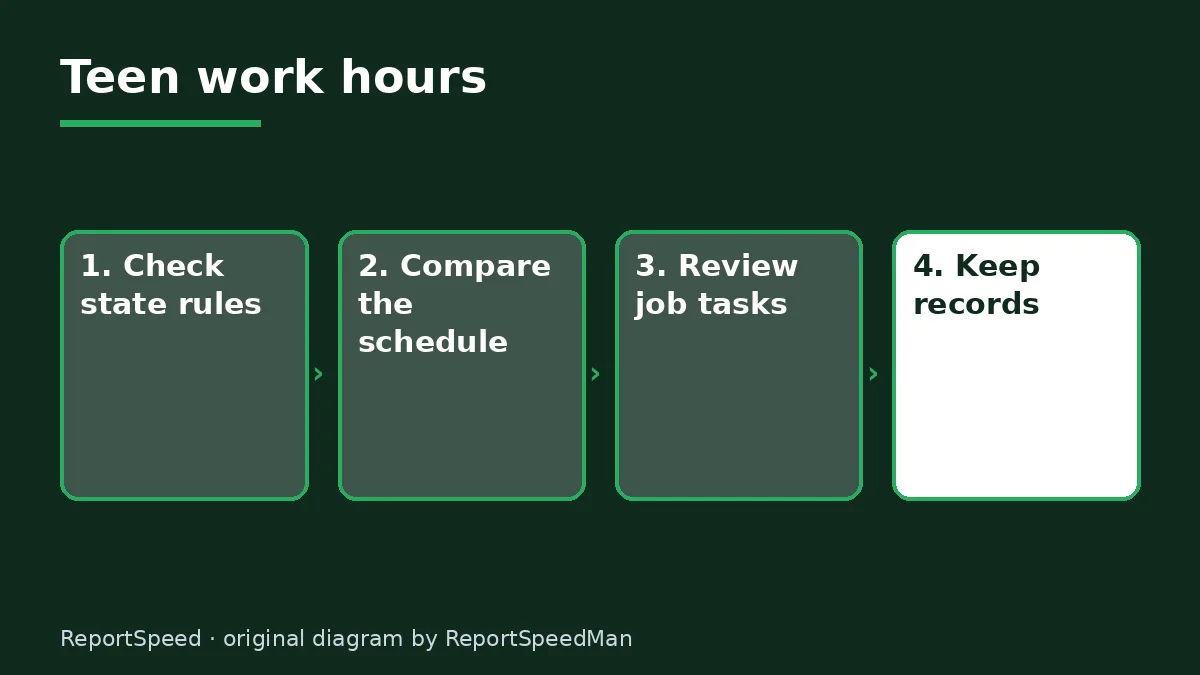
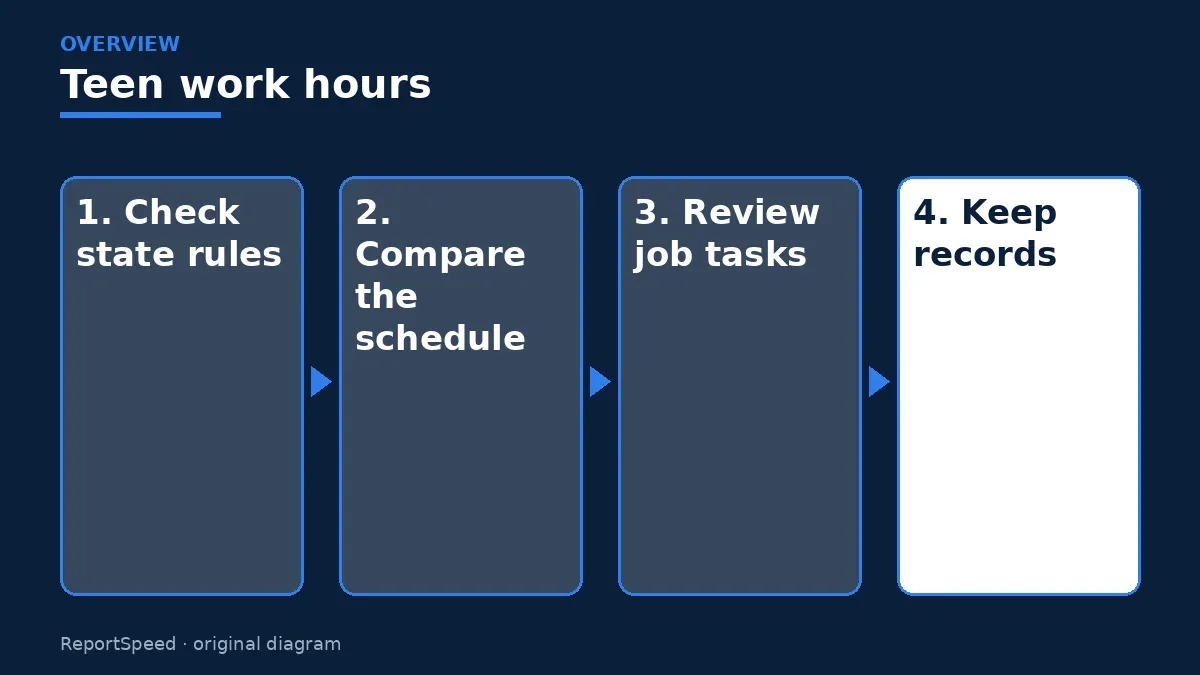
- Check your state's child labor rules and whether a work permit is required.
- Compare the offered schedule with the federal limits for school and non-school weeks.
- Ask the manager to end school-night shifts by 7 p.m. outside summer.
- Ask which tasks he'll do and check them against federal hazardous work limits.
- Keep a copy of his schedule and pay stubs.
- If rules aren't followed, contact the DOL Wage and Hour Division.
Common mistakes:
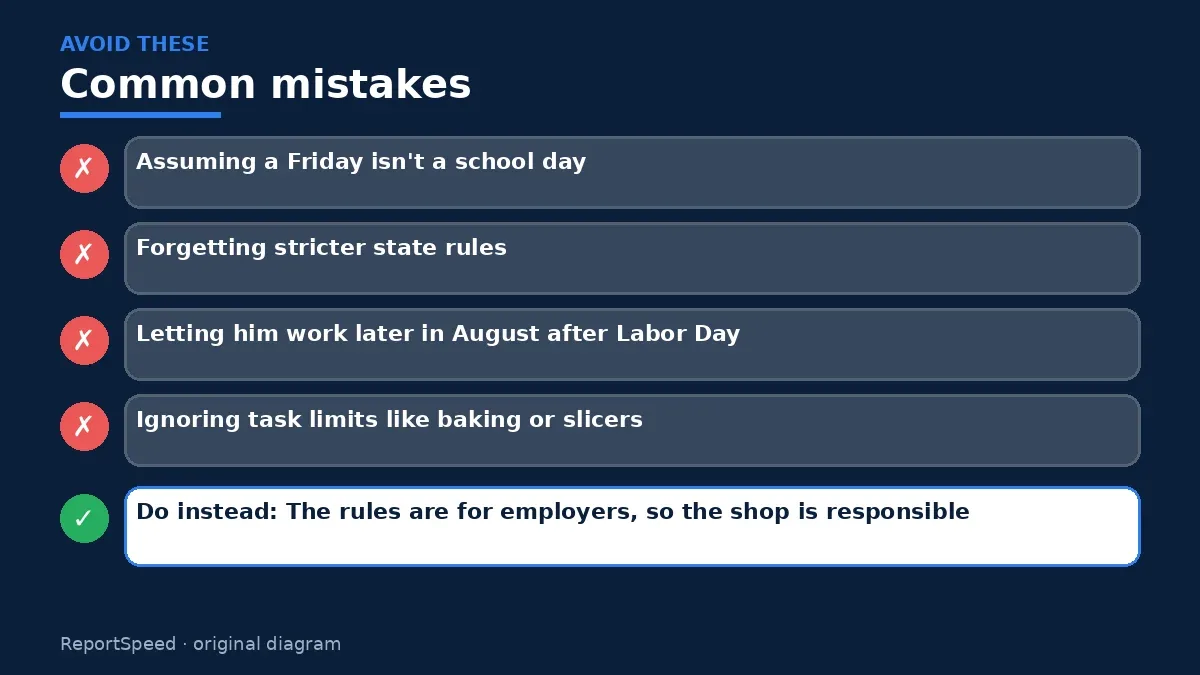
- Assuming a Friday isn't a school day
- Forgetting stricter state rules
- Letting him work later in August after Labor Day
- Ignoring task limits like baking or slicers
ReportSpeedMan tip: The rules are for employers, so the shop is responsible. Still, a polite note with the YouthRules link usually fixes a schedule problem in one conversation.
What I would actually do
I'd ask the manager for school-night shifts ending by 7 p.m. and longer weekend shifts, and check our state's work permit rules.
The trade-off people miss: more hours mean more pay, but the limits exist to protect school and sleep; a good first job works within them.
Signs it worked
His schedule fits the federal and state limits.
Quick FAQ
Does Friday count as a school day?
Yes.
Can he work until 9 p.m.?
Only June 1 through Labor Day.
Does he need a permit?
It depends on your state.
Wrap-up: At 14 or 15: 3 hours on school days, 18 in school weeks, 7 a.m. to 7 p.m., or 9 p.m. in summer. Check state rules and task limits too.
Wiki: Kids and Screen Time and Wage and Hour Basics (FLSA).
How many hours can a 14- or 15-year-old work: official pages behind this answer
Step-by-step photos

1. Before The problem 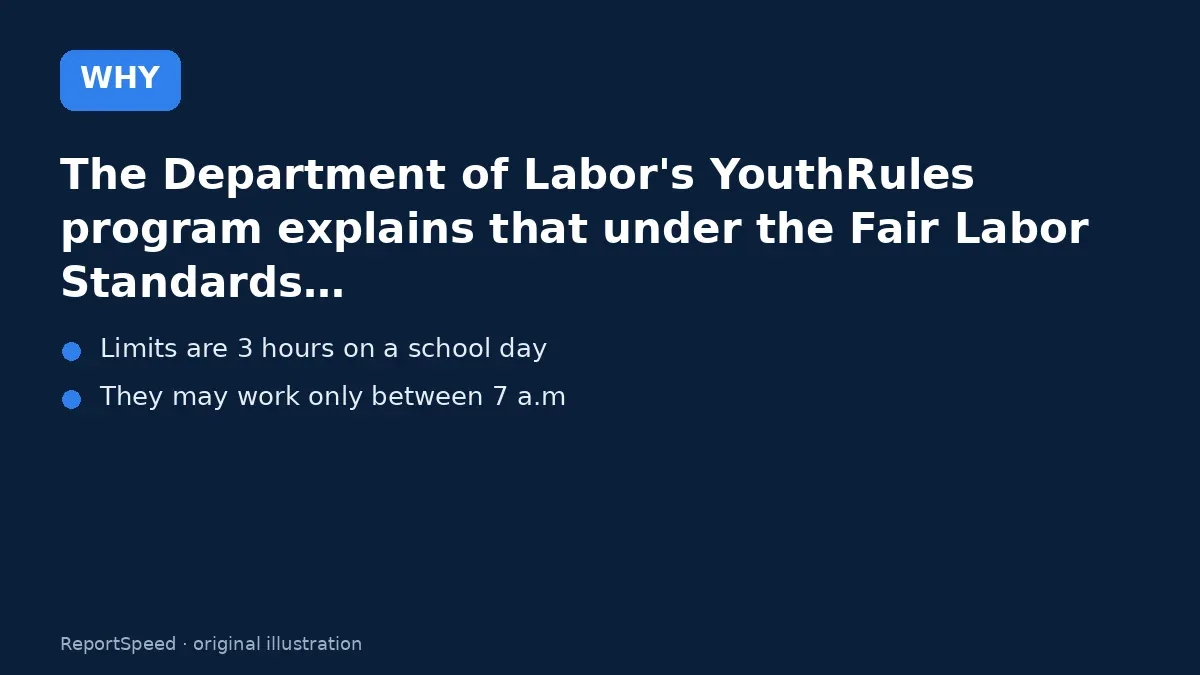
2. Why it happens The cause 
3. The fix The fix 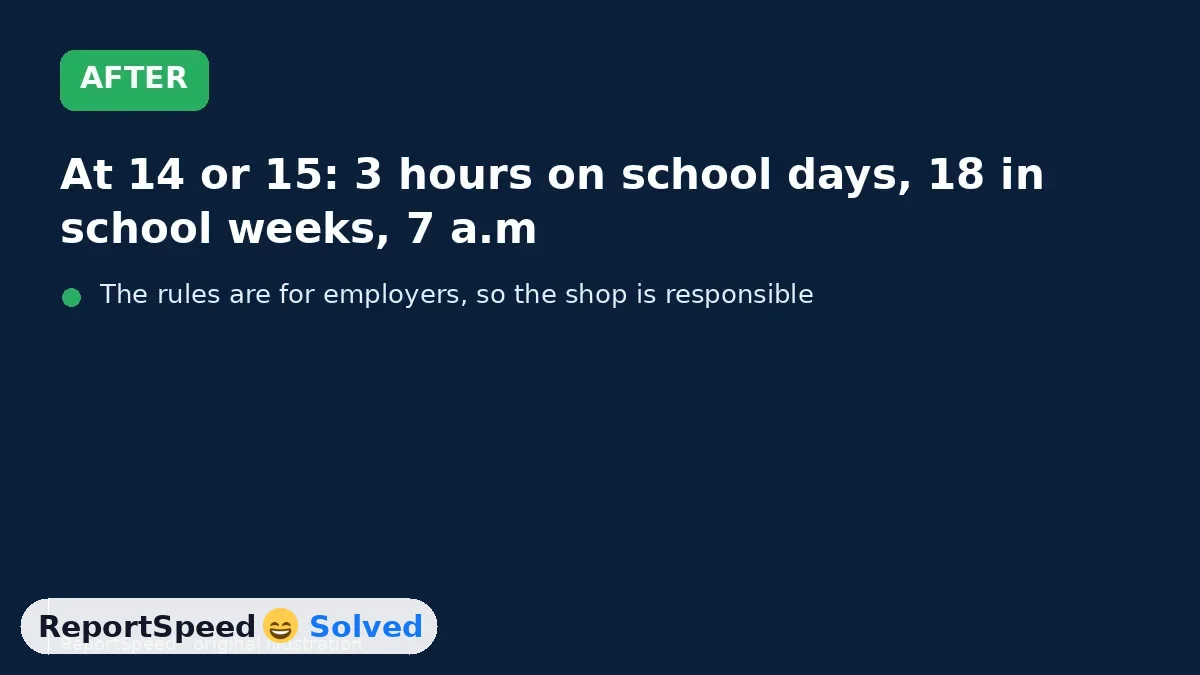
4. After The result
⚡ Speed Summary
- At 14 or 15: 3 hours on school days, 18 in school weeks, 7 a.m.
- The rules are for employers, so the shop is responsible. Still, a polite note with the YouthRules link usually fixes a schedule problem in one conversation.
- An 8 p.m. finish on a school night breaks the federal 7 p.m. limit outside the summer window, no matter how short the shift.

Was this answer helpful?
Tap a star to rate this answer.
Related questions
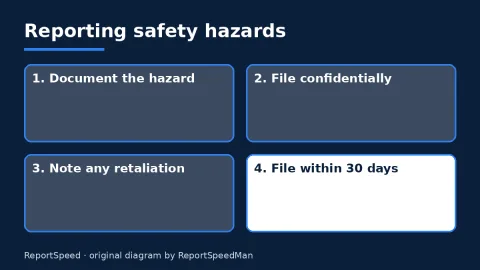
Can I be fired for reporting a safety problem at work? OSHA's 30-day rule
You can report hazards confidentially, and retaliation is illegal.
Rate itSolved

Pregnant at work: what accommodations can I ask for under the PWFA?
Under the PWFA, employers with 15+ workers must reasonably accommodate pregnancy limitations.
Rate itSolved
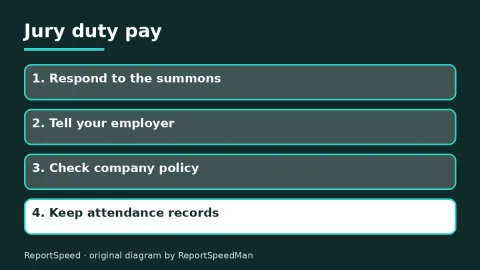
Do I get paid for jury duty, and can my employer fire me for going?
Federal jurors earn $50 a day; employer pay is optional, but firing you for federal jury service is illegal.
Rate itSolved
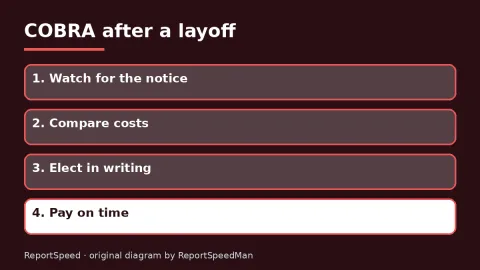
COBRA after a layoff: how long, how much and the deadlines
COBRA usually lasts 18 months, costs up to 102% of the premium, and gives you 60 days to elect and 45 days to pay.
Rate itSolved
Real experiences
No experiences yet. Be the first to share.