


I left my salaried job this year and now I freelance full-time. Nobody is withholding tax from my pay anymore. A friend said I should be sending the IRS money every quarter or I'll get a penalty. Do I need to make estimated tax payments, and what are the actual due dates?
Do I need to make estimated tax payments, and when are they due?
Concerns & risks
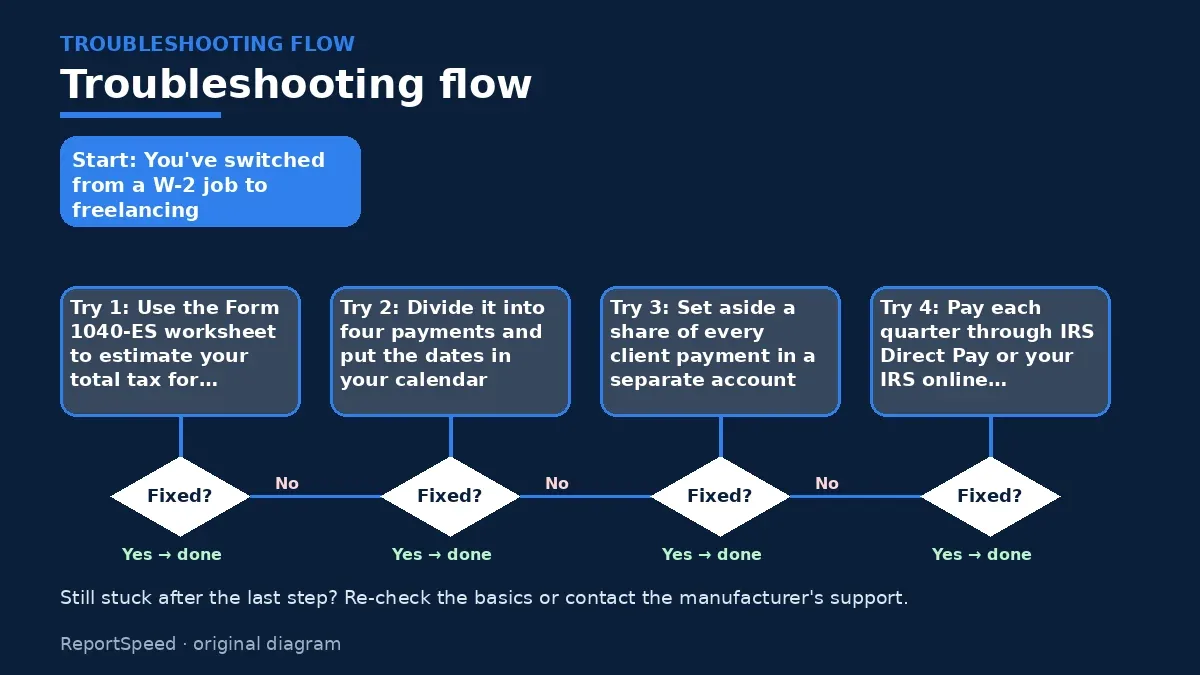
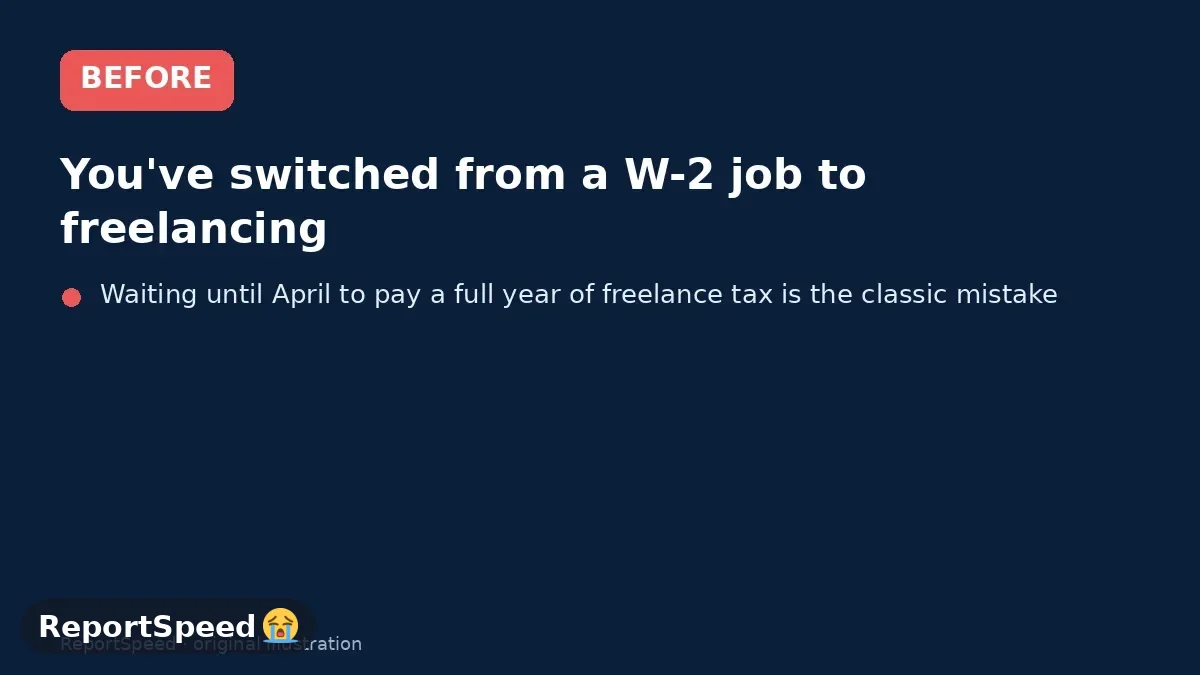
You've switched from a W-2 job to freelancing, and no tax is being withheld from your income anymore.
| When | Do this |
|---|---|
| Every client payment | Move a set share to a tax account |
| Two weeks before each due date | Recheck income so far |
| Due date | Pay via Direct Pay or online account |
| After paying | Save the confirmation |
| Year end | Compare payments with Form 1040-ES estimate |
Causes & evidence
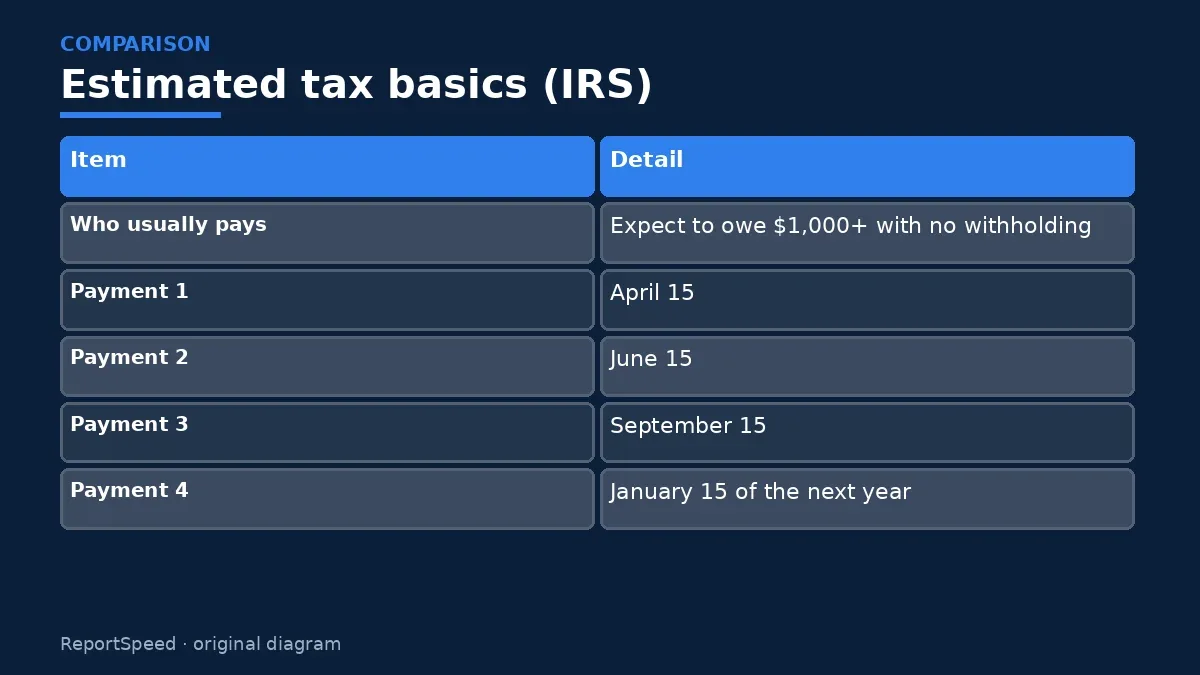
The IRS explains that the U.S. tax system is pay-as-you-go: tax must be paid as you earn income, through withholding or estimated payments. People who are self-employed or have other income without withholding generally need to make estimated payments if they expect to owe $1,000 or more when they file. Payments are split into four periods, usually due April 15, June 15, September 15 and January 15 of the following year, moving to the next business day when a date falls on a weekend or holiday. You can pay through IRS Direct Pay, your IRS online account or EFTPS. If you pay too little or too late, the IRS may charge a penalty even if you get a refund later. Form 1040-ES includes a worksheet to estimate what you owe, including self-employment tax.
Who this applies to: estimated payments are for income without enough withholding, such as freelance or gig pay, rental income, interest and dividends, or large investment gains. Penalties can often be avoided if your total withholding and estimated payments meet safe-harbor amounts set by the IRS, generally based on this year's or last year's tax; check the current Form 1040-ES instructions. Farmers, fishers and higher-income taxpayers have special rules. State income tax may require separate estimated payments.
Waiting until April to pay a full year of freelance tax is the classic mistake, because the penalty is based on each quarter you underpaid.
What to do
| Item | Detail |
|---|---|
| Who usually pays | Expect to owe $1,000+ with no withholding |
| Payment 1 | April 15 |
| Payment 2 | June 15 |
| Payment 3 | September 15 |
| Payment 4 | January 15 of the next year |
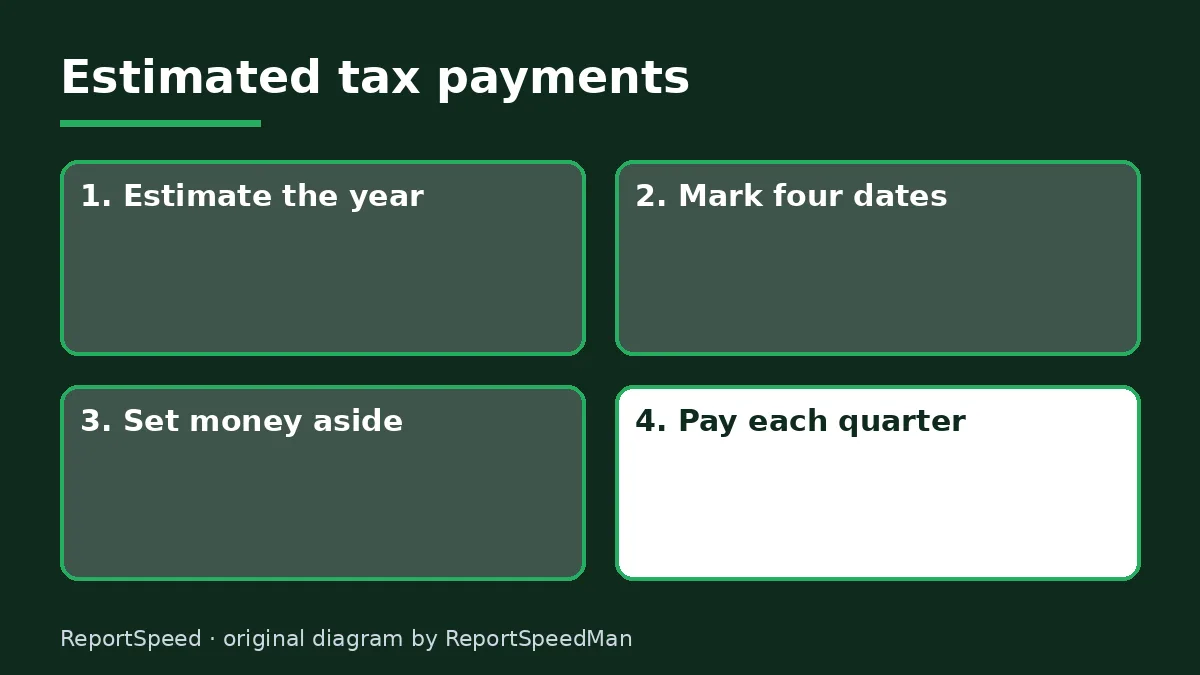
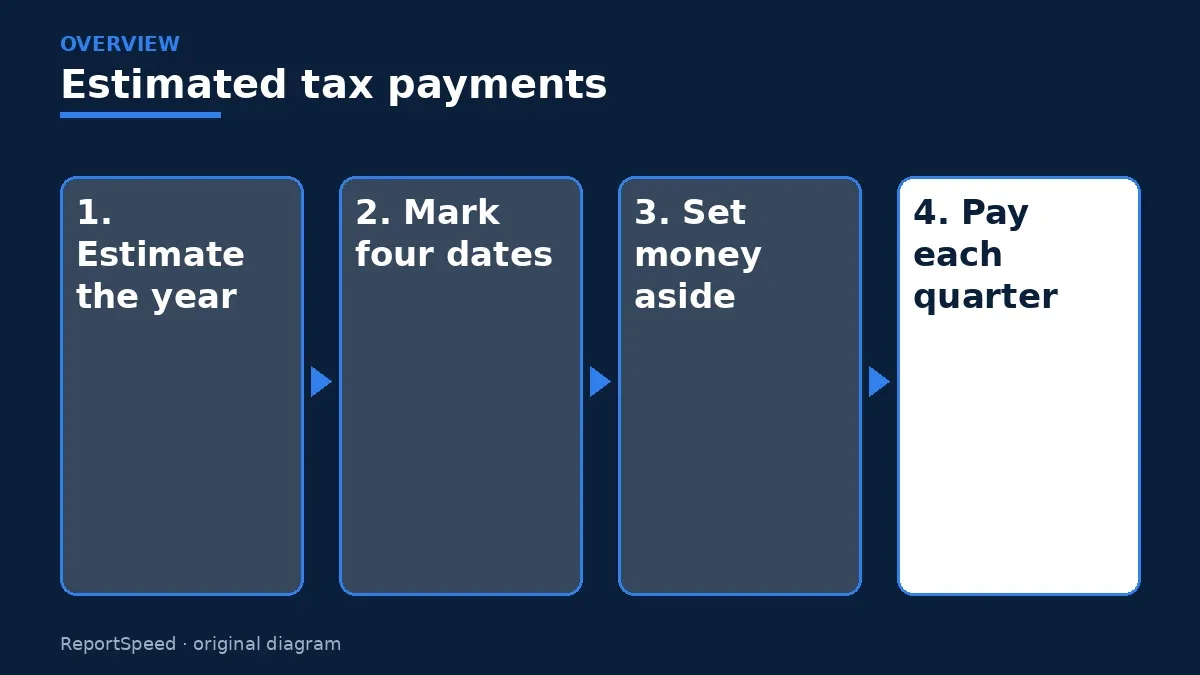
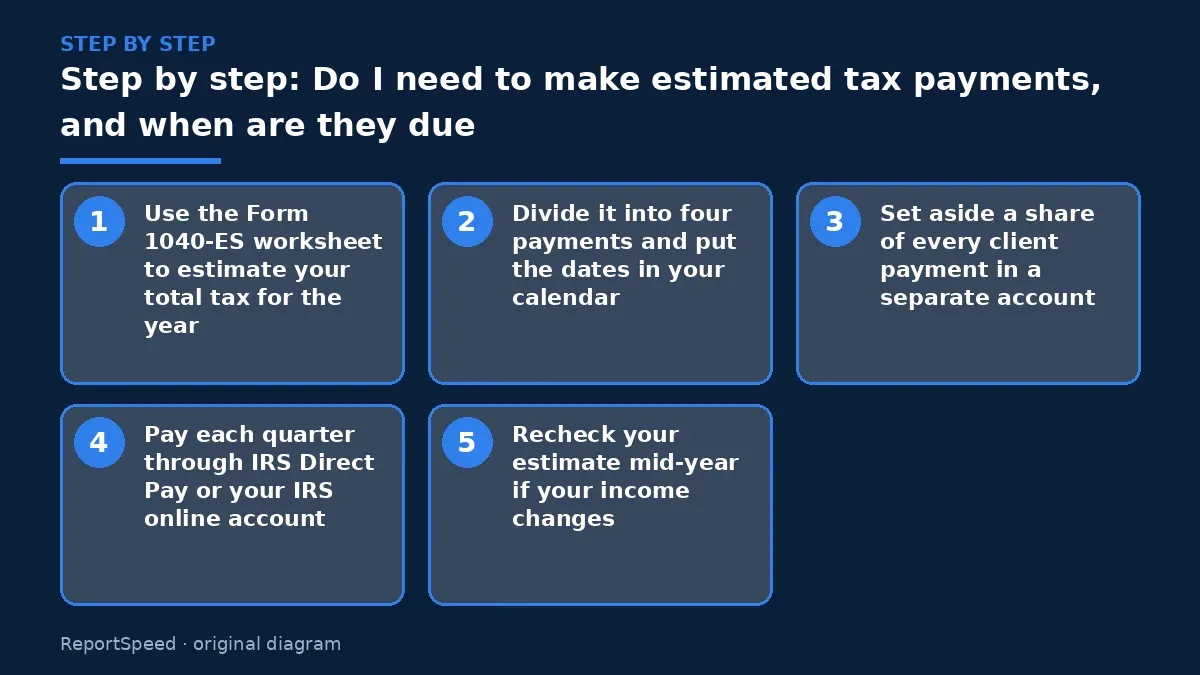
- Use the Form 1040-ES worksheet to estimate your total tax for the year.
- Divide it into four payments and put the dates in your calendar.
- Set aside a share of every client payment in a separate account.
- Pay each quarter through IRS Direct Pay or your IRS online account.
- Recheck your estimate mid-year if your income changes.
Common mistakes:
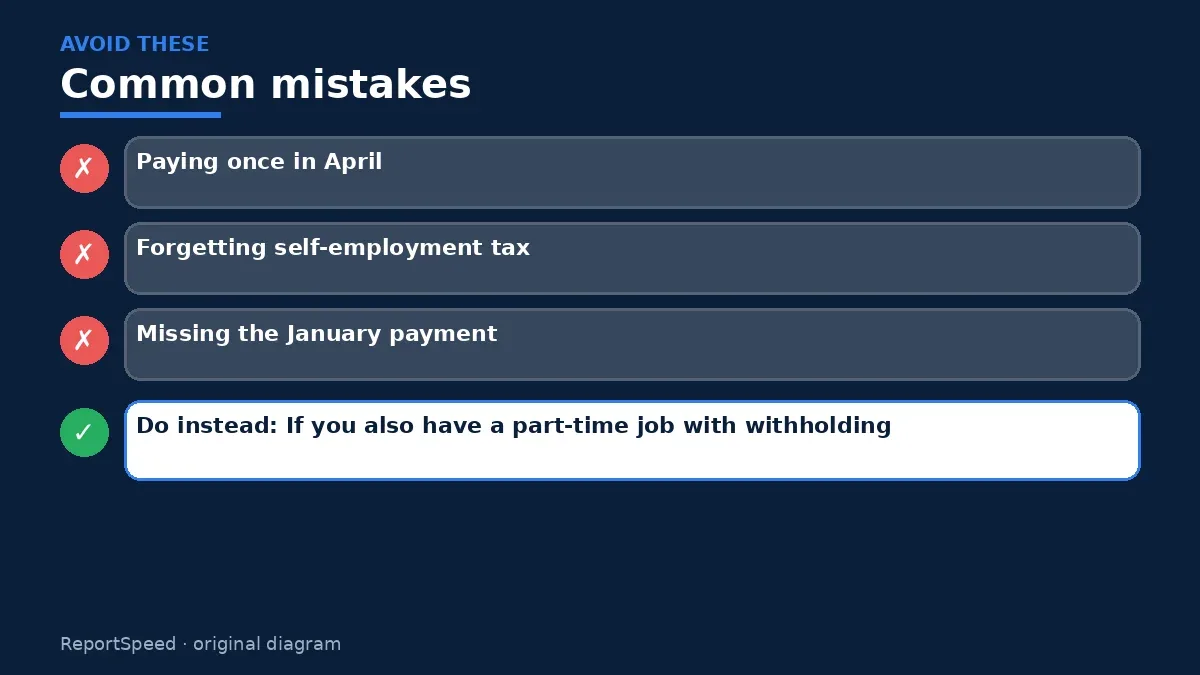
- Paying once in April
- Forgetting self-employment tax
- Missing the January payment
ReportSpeedMan tip: If you also have a part-time job with withholding, raising that withholding on Form W-4 can reduce or replace estimated payments.
What I would actually do
I'd move a fixed share of every client payment into a separate savings account the day it lands, and set four calendar reminders a week before each due date.
The trade-off people miss: paying too much each quarter just means a refund later, while paying too little can mean a penalty, so erring slightly high is usually the calmer option when income is unpredictable.
Signs it worked
All four payments are made on time and April brings no surprises.
Quick FAQ
What if I miss a payment?
Pay as soon as possible; any penalty is based on how long it was late.
Can I pay more than four times?
Yes. What matters is enough paid by each due date.
Do I need to file anything with each payment?
Online payments don't need a voucher; mailed checks use the 1040-ES voucher.
Wrap-up: With no withholding, plan on four estimated payments: April 15, June 15, September 15 and January 15. Estimate with Form 1040-ES and pay each quarter on time.
Wiki: Tax Withholding and Form W-4 and Emergency Fund.
Do I need to make estimated tax payments, and when are they due: read the originals
Step-by-step photos
1. Before The problem 
2. Why it happens The cause 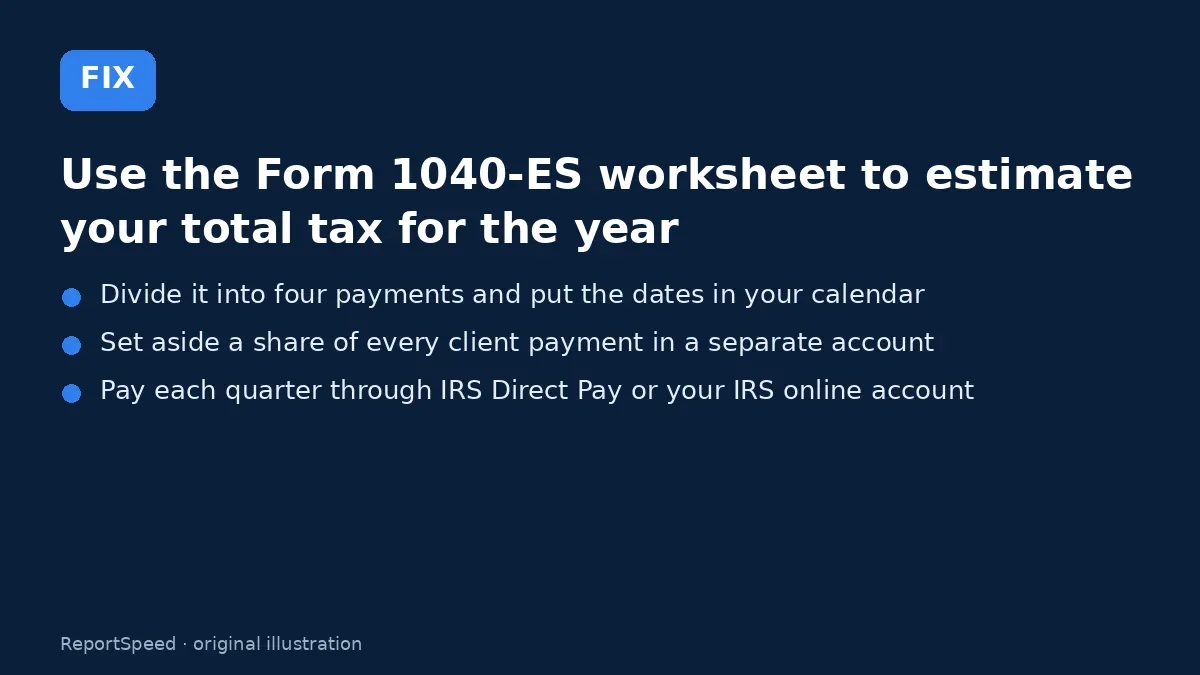
3. The fix The fix 
4. After The result
⚡ Speed Summary
- With no withholding, plan on four estimated payments: April 15, June 15, September 15 and January 15.
- If you also have a part-time job with withholding, raising that withholding on Form W-4 can reduce or replace estimated payments.
- Waiting until April to pay a full year of freelance tax is the classic mistake, because the penalty is based on each quarter you underpaid.

Was this answer helpful?
Tap a star to rate this answer.
Related questions
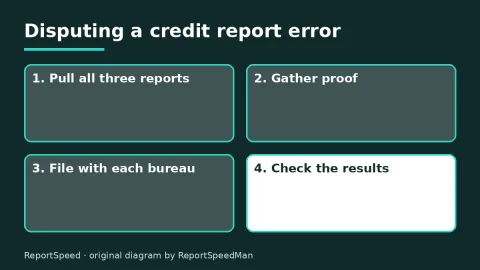
Found an error on my credit report? How to dispute it step by step
Dispute with each bureau and the furnisher, include proof, and expect results in about 30 days.
Rate itSolved
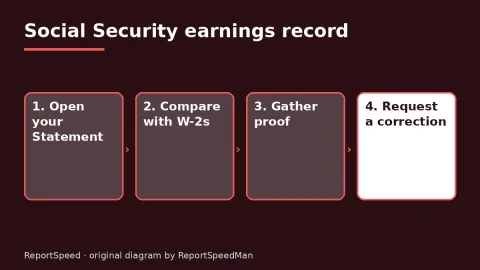
How do I check my Social Security earnings record and fix a mistake?
Check your Statement every year, match it to your W-2s, and correct gaps with proof before the usual window closes.
Rate itSolved
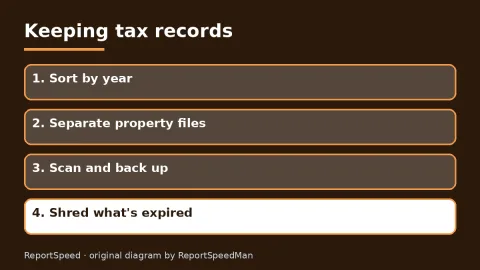
How long should I keep tax records? The IRS 3-, 6- and 7-year rules
Three years covers most returns; six, seven or forever apply in specific cases.
Rate itSolved
What happens if I only pay the minimum on my credit card?
Minimum payments keep you current but stretch the debt for years.
Rate itSolved
Real experiences
No experiences yet. Be the first to share.