


I turn 62 next year and my friends keep telling me to claim Social Security as soon as I can, while my brother says waiting until 70 is the only smart move. I was born in 1964. How do I decide when to claim Social Security, and how much difference does the age really make?
When should I claim Social Security: 62, 67 or 70?

Concerns & risks
You were born in 1964, you can start benefits next year, and you're hearing opposite advice from people you trust.
| Situation | Why it matters |
|---|---|
| Married, higher earner | Your benefit can become a survivor benefit |
| Still working before 67 | Earnings test can withhold benefits |
| Good health, long family lifespan | Delay can pay more over time |
| Need income now, few savings | Earlier claim may be necessary |
| Want to apply | About 4 months before start |

Causes & evidence
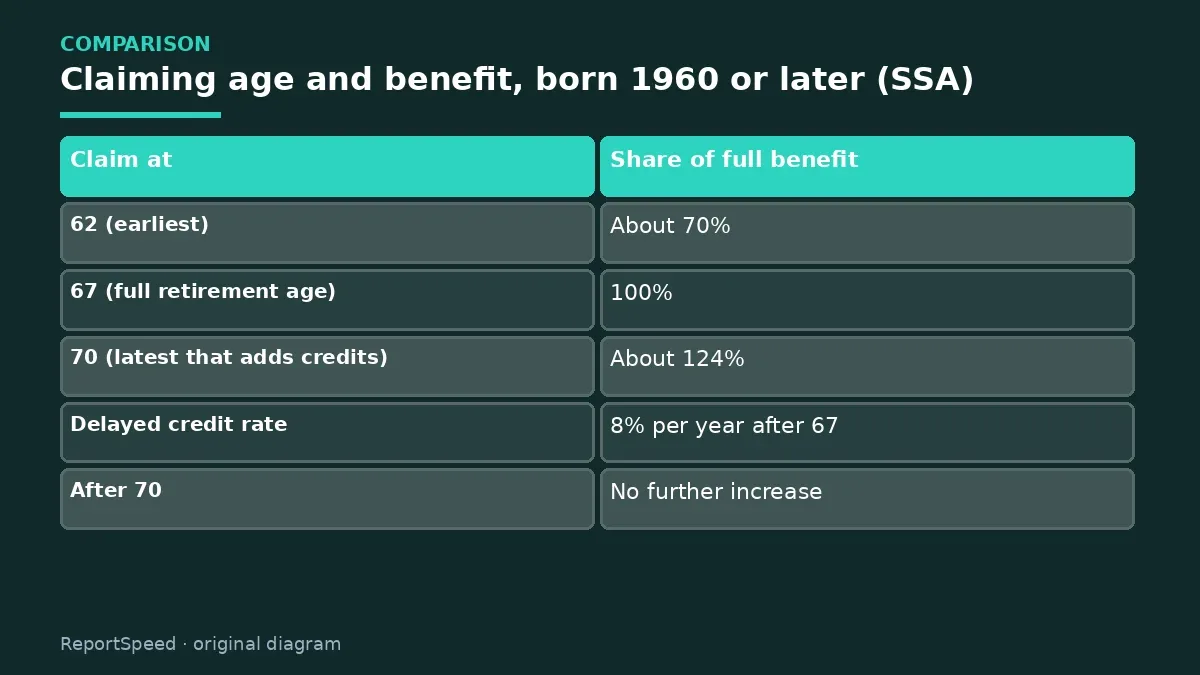
The Social Security Administration sets your full retirement age by birth year, and for anyone born in 1960 or later it is 67. You can start retirement benefits as early as 62, but SSA explains that claiming at 62 permanently reduces your own benefit to about 70% of the full amount, a 30% cut. If you wait past full retirement age, you earn delayed retirement credits of 8% a year (two-thirds of 1% per month), so claiming at 70 pays about 124% of your full benefit. Credits stop at 70, so there is no gain from waiting longer. Your exact figures depend on your own earnings record, which you can see in your my Social Security account. Health, other income, marriage and whether you keep working all affect which age makes sense.
Who this applies to: the figures here are for your own retirement benefit if you were born in 1960 or later. Spousal benefits follow different reduction rules, and survivor benefits can start as early as 60. If you claim before full retirement age and keep working, SSA's earnings test may temporarily withhold some benefits, which are credited back later. Medicare eligibility at 65 is separate from when you claim Social Security.

Picking an age because of what a friend did, rather than your own earnings record and health, is the most common way people lock in a check that doesn't fit them.
What to do

| Claim at | Share of full benefit |
|---|---|
| 62 (earliest) | About 70% |
| 67 (full retirement age) | 100% |
| 70 (latest that adds credits) | About 124% |
| Delayed credit rate | 8% per year after 67 |
| After 70 | No further increase |
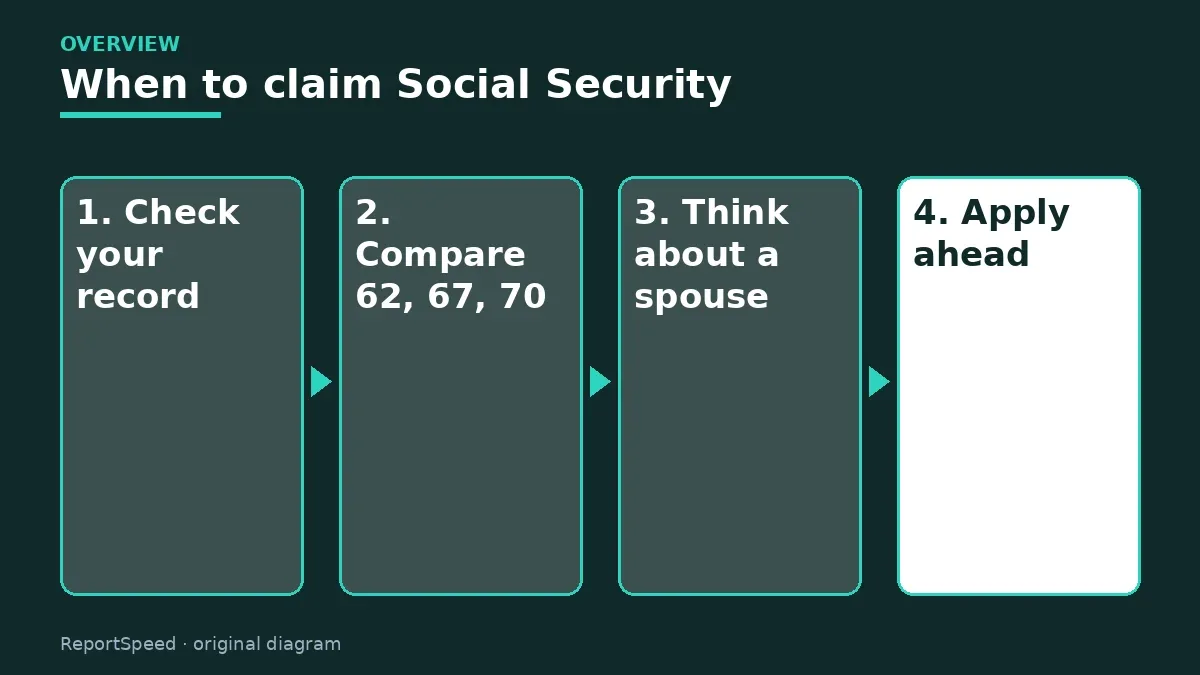
- Create or sign in to your my Social Security account and download your benefit estimates.
- Write down your estimated monthly amount at 62, 67 and 70.
- List your other income and savings for the years before each age.
- If married, check how your choice affects spousal and survivor benefits.
- Apply about four months before the month you want benefits to start.

Common mistakes:
- Claiming early just because friends did
- Ignoring survivor benefits for a spouse
- Forgetting that working while claiming early can temporarily withhold benefits
ReportSpeedMan tip: SSA's online calculators use your actual earnings record, so they're more useful than any rule of thumb you'll hear at a barbecue.
What I would actually do
I'd pull my SSA estimates, map out what I'd live on from 62 to 70, and only claim early if savings genuinely couldn't bridge the gap. If married, I'd lean on the higher earner delaying.
The trade-off people miss: a bigger check at 70 only pays off if you live long enough to collect it, and the early-claim 'break-even' depends on your health. For couples, the higher earner's choice also sets the survivor benefit the other may live on for years.
Proof that it worked
You've chosen a claiming age based on your own SSA estimates and filed on schedule.
Quick FAQ
Can I change my mind after claiming?
SSA allows a withdrawal within 12 months of first entitlement, but you must repay benefits received.
Does claiming at 62 affect my spouse?
It can reduce the survivor benefit your spouse might later receive.
Do I get more by waiting past 70?
No. Delayed credits stop at 70.
Wrap-up: For someone born in 1964, 67 is the full retirement age, 62 pays about 70% and 70 pays about 124%. Check your own record, weigh health and other income, then choose.
Wiki: Compound Interest and Emergency Fund.
When should I claim Social Security: where the facts come from
Step-by-step photos

1. Before The problem 
2. Why it happens The cause 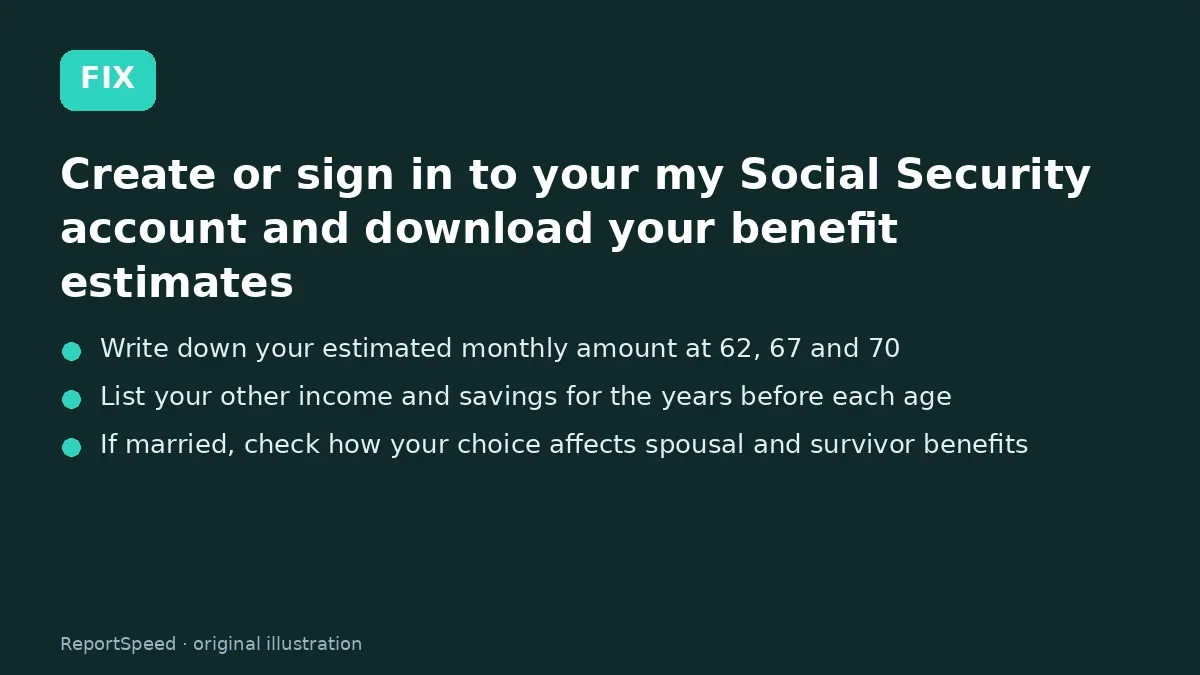
3. The fix The fix 
4. After The result
⚡ Speed Summary
- For someone born in 1964, 67 is the full retirement age, 62 pays about 70% and 70 pays about 124%.
- SSA's online calculators use your actual earnings record, so they're more useful than any rule of thumb you'll hear at a barbecue.
- Picking an age because of what a friend did, rather than your own earnings record and health, is the most common way people lock in a check that doesn't fit them.

Was this answer helpful?
Tap a star to rate this answer.
Related questions
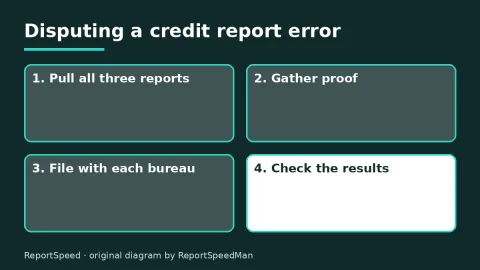
Found an error on my credit report? How to dispute it step by step
Dispute with each bureau and the furnisher, include proof, and expect results in about 30 days.
Rate itSolved
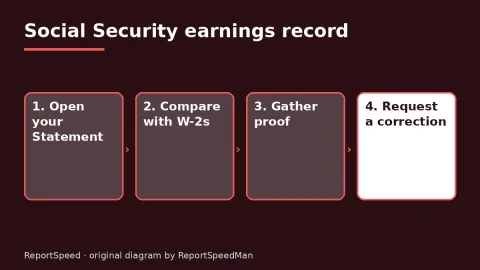
How do I check my Social Security earnings record and fix a mistake?
Check your Statement every year, match it to your W-2s, and correct gaps with proof before the usual window closes.
Rate itSolved
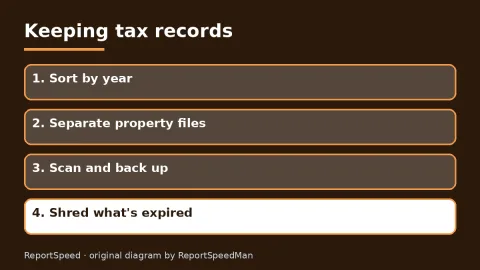
How long should I keep tax records? The IRS 3-, 6- and 7-year rules
Three years covers most returns; six, seven or forever apply in specific cases.
Rate itSolved
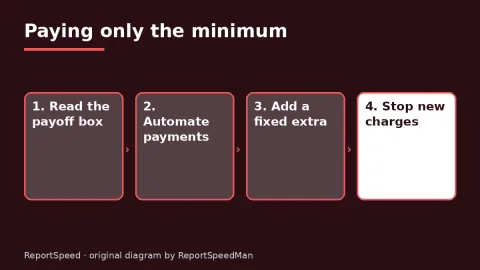
What happens if I only pay the minimum on my credit card?
Minimum payments keep you current but stretch the debt for years.
Rate itSolved
Real experiences
No experiences yet. Be the first to share.