


I'm paid $18 an hour at a warehouse. Last week I worked 46 hours, plus I got a $50 attendance bonus. My check only shows overtime at $27 an hour and my coworker says the bonus should count too. How is overtime pay calculated, and how do I check my paycheck?
How is overtime pay calculated? Time and a half explained

Concerns & risks
You're an hourly worker who worked 46 hours and earned a bonus, and you want to check your overtime math.
| Item | Amount |
|---|---|
| 46 hours x $18 | $828 |
| Plus $50 attendance bonus | $878 |
| Regular rate: $878 ÷ 46 | About $19.09 |
| Overtime premium: 6 x half the rate | About $57.26 |
| Total owed | About $935.26 |


Causes & evidence
The Fair Labor Standards Act requires covered, non-exempt employees to receive overtime pay of at least one and one-half times their regular rate of pay for hours worked over 40 in a workweek. A workweek is a fixed, recurring period of 168 hours (seven consecutive 24-hour periods); each workweek stands alone, so hours can't be averaged across two weeks. The regular rate isn't always just the hourly wage: DOL Fact Sheet 23 explains that it generally includes nondiscretionary bonuses, such as attendance or production bonuses promised in advance, while discretionary bonuses and some other payments are excluded. Federal law doesn't require overtime for weekends or holidays as such, or for more than eight hours in a day, though some states, such as California, have daily overtime rules. Employers must keep accurate time records, and you can contact the Wage and Hour Division if you think you're underpaid.
Who this applies to: overtime rules apply to non-exempt employees. Some salaried employees are also non-exempt and owed overtime. A few industries have special rules, and public-sector employers can sometimes give comp time instead of overtime pay. State laws may add daily overtime or other protections, and you're owed the more generous rule.
Assuming overtime is always exactly 1.5 times your base wage can hide underpayment when nondiscretionary bonuses should raise your regular rate.
What to do
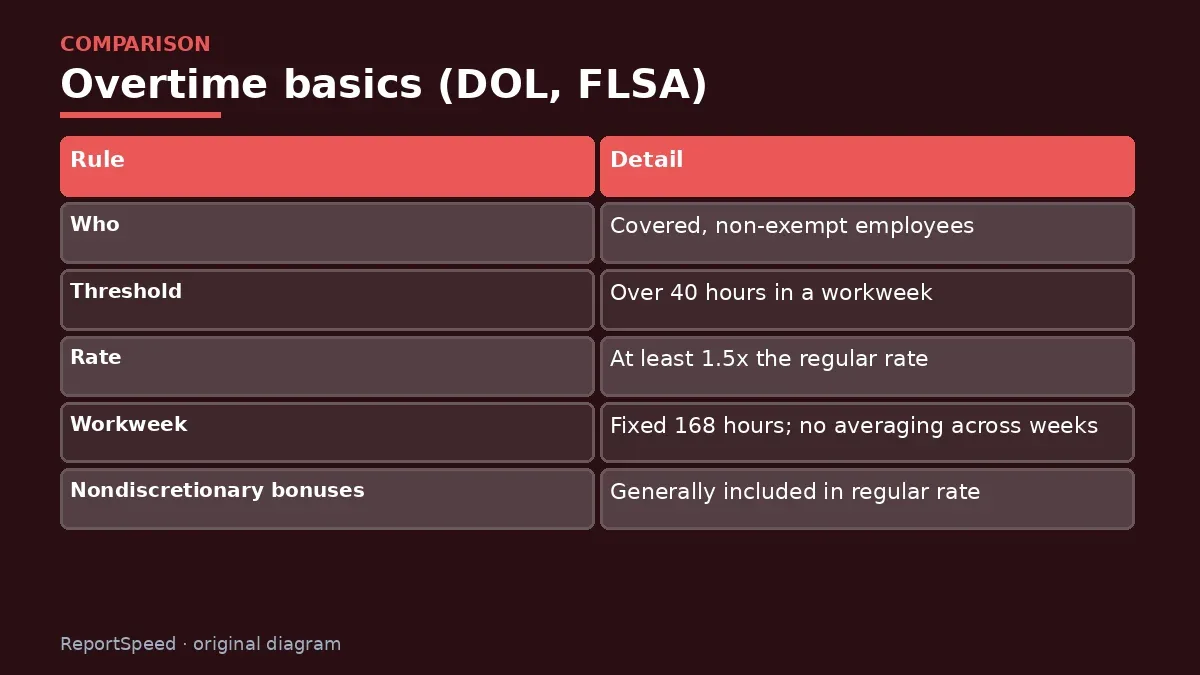
| Rule | Detail |
|---|---|
| Who | Covered, non-exempt employees |
| Threshold | Over 40 hours in a workweek |
| Rate | At least 1.5x the regular rate |
| Workweek | Fixed 168 hours; no averaging across weeks |
| Nondiscretionary bonuses | Generally included in regular rate |
| Daily overtime | Not federal; some states require it |
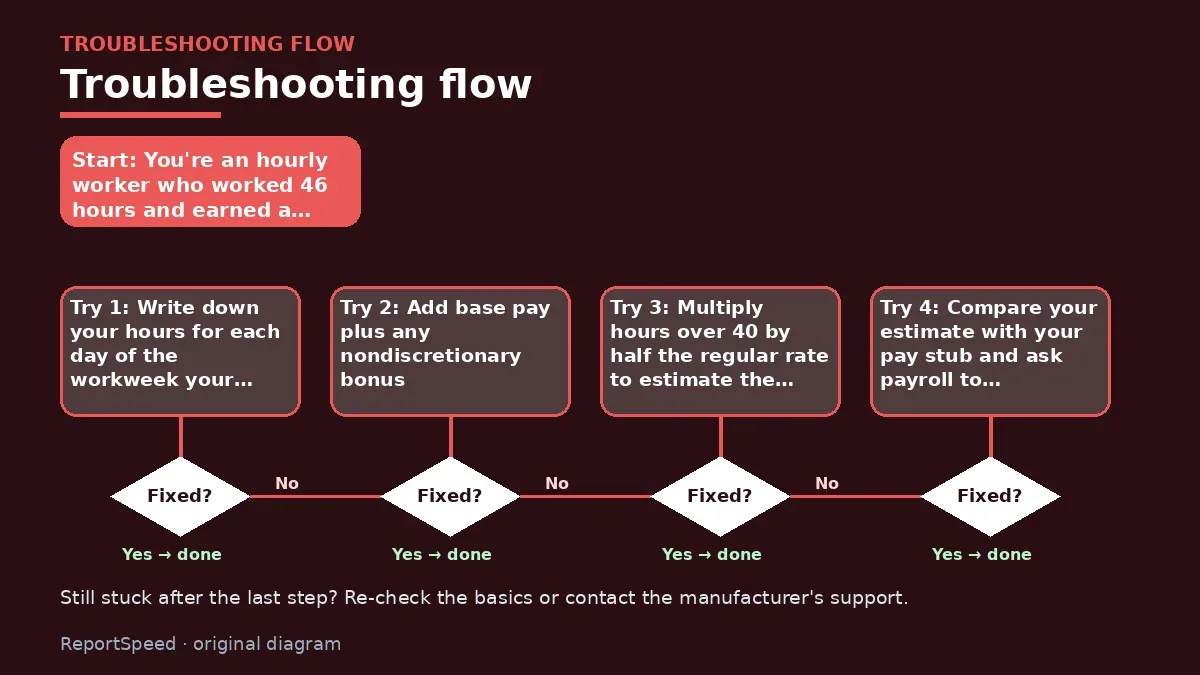
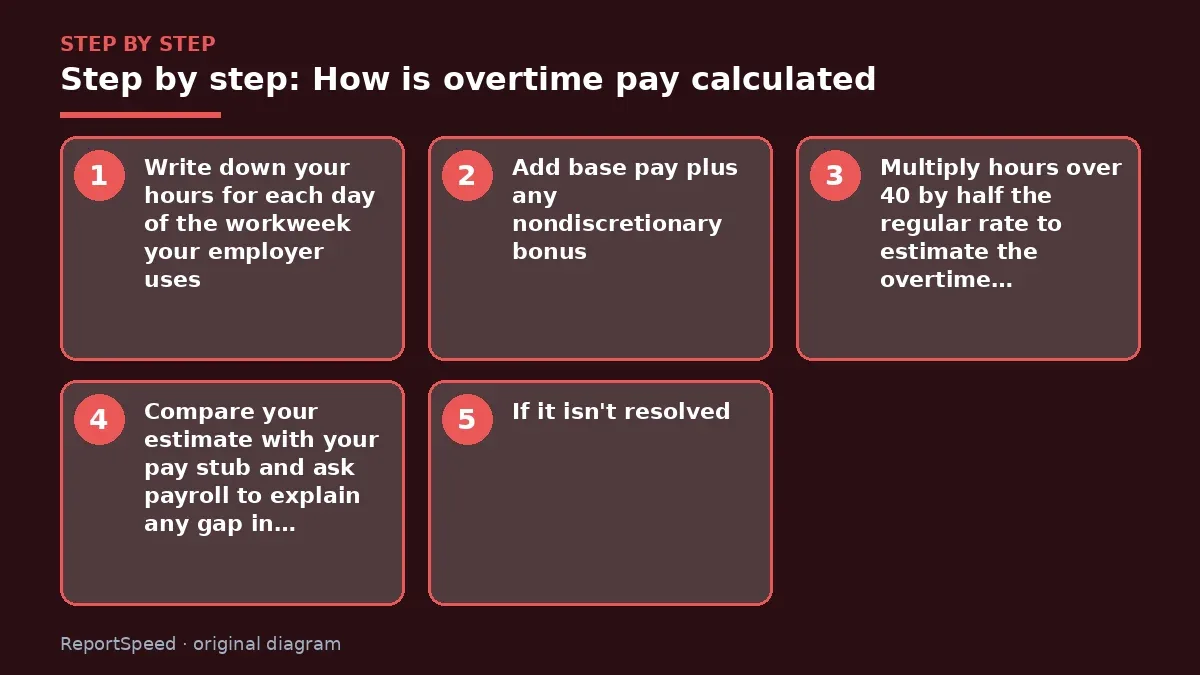
- Write down your hours for each day of the workweek your employer uses.
- Add base pay plus any nondiscretionary bonus, then divide by total hours to estimate the regular rate.
- Multiply hours over 40 by half the regular rate to estimate the overtime premium owed on top.
- Compare your estimate with your pay stub and ask payroll to explain any gap in writing.
- If it isn't resolved, contact the Wage and Hour Division or your state labor agency.
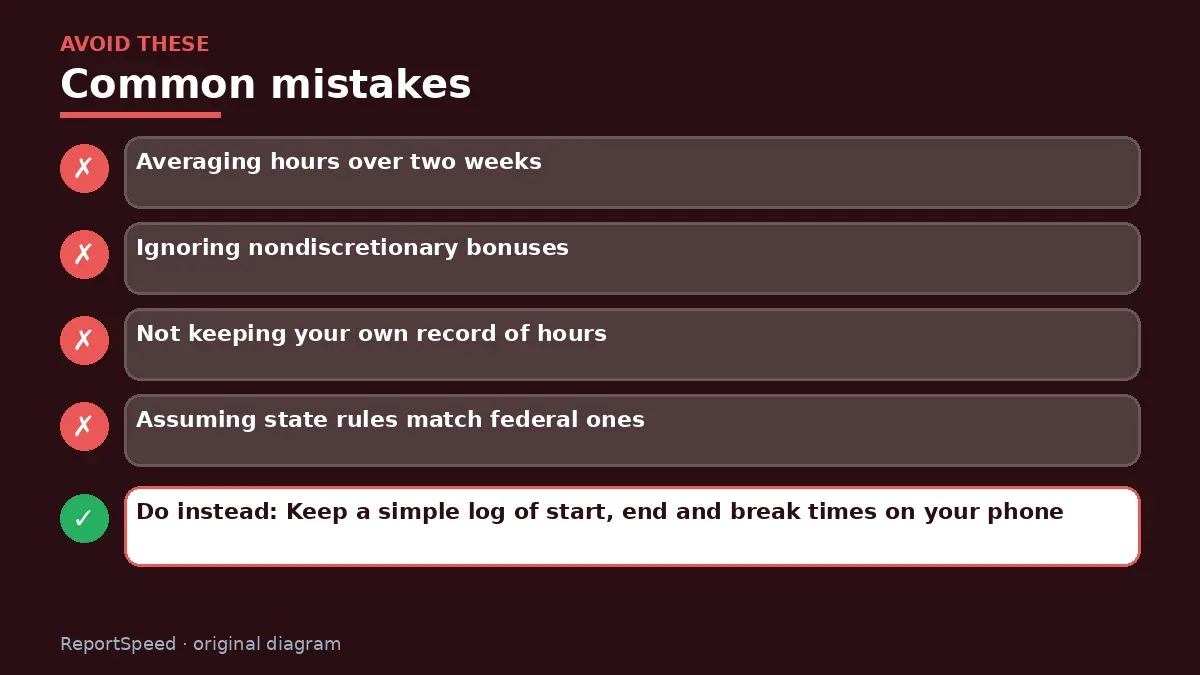
Common mistakes:
- Averaging hours over two weeks
- Ignoring nondiscretionary bonuses
- Not keeping your own record of hours
- Assuming state rules match federal ones
ReportSpeedMan tip: Keep a simple log of start, end and break times on your phone. Your own records help if your employer's records are wrong.
What I would actually do
I'd keep my own log of hours, work out the regular rate with the bonus included, and send payroll a short, polite email showing my math.
The trade-off people miss: an exact amount owed depends on how your bonus is structured and your state's rules, so treat your own estimate as a starting point for a conversation, not a final answer.
How to tell it worked
Your pay stub matches your overtime estimate.
Quick FAQ
Can my employer make me work overtime?
Federal law generally allows it, but it must be paid.
Do paid holidays count toward 40 hours?
Under federal law, only hours worked count.
How far back can I claim?
Generally two years, or three for willful violations.
Wrap-up: Non-exempt workers get at least 1.5 times the regular rate for hours over 40 in a workweek, and that rate generally includes nondiscretionary bonuses. Check your stub and ask payroll about gaps.
Wiki: Tax Withholding and Form W-4 and Wage and Hour Basics (FLSA).
How is overtime pay calculated: primary sources
Step-by-step photos

1. Before The problem 
2. Why it happens The cause 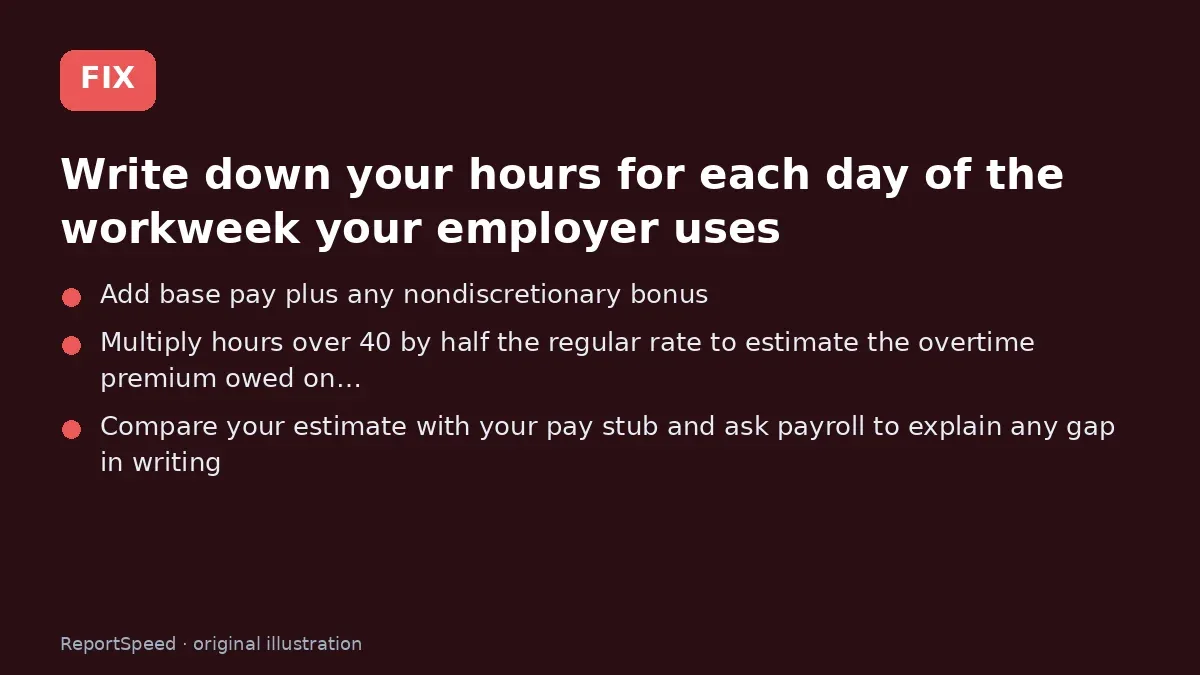
3. The fix The fix 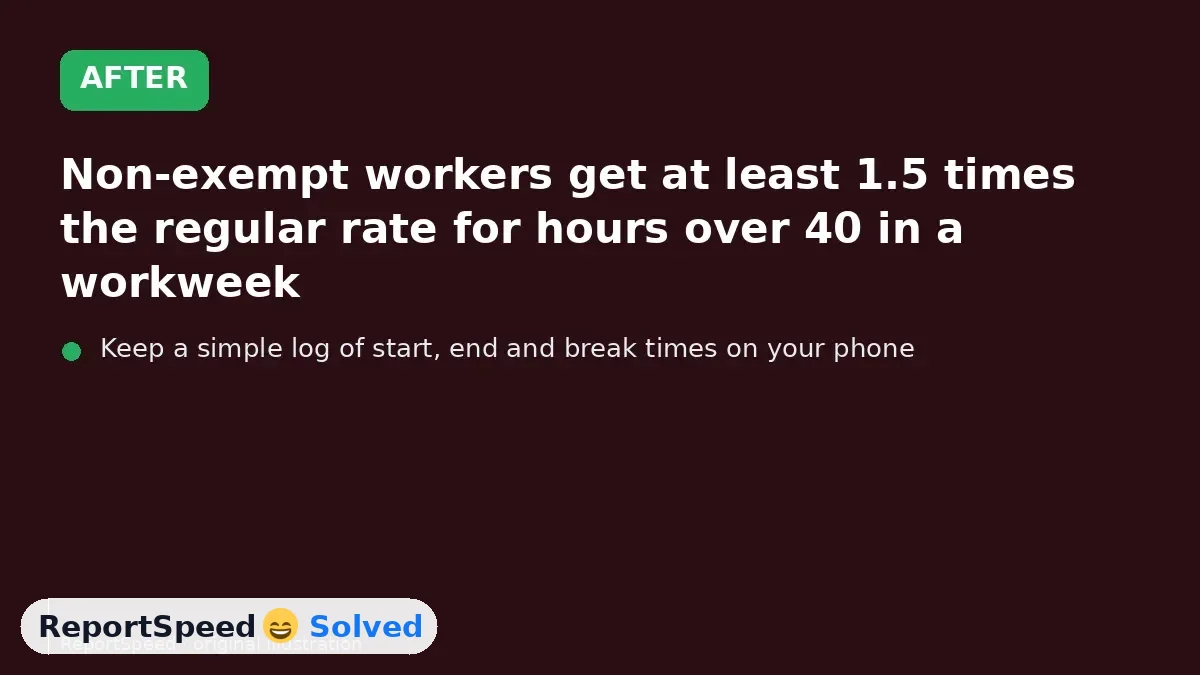
4. After The result
⚡ Speed Summary
- Non-exempt workers get at least 1.5 times the regular rate for hours over 40 in a workweek, and that rate generally includes nondiscretionary bonuses.
- Keep a simple log of start, end and break times on your phone. Your own records help if your employer's records are wrong.
- Assuming overtime is always exactly 1.5 times your base wage can hide underpayment when nondiscretionary bonuses should raise your regular rate.

Was this answer helpful?
Tap a star to rate this answer.
Related questions
Can I be fired for reporting a safety problem at work? OSHA's 30-day rule
You can report hazards confidentially, and retaliation is illegal.
Rate itSolved

Pregnant at work: what accommodations can I ask for under the PWFA?
Under the PWFA, employers with 15+ workers must reasonably accommodate pregnancy limitations.
Rate itSolved
Do I get paid for jury duty, and can my employer fire me for going?
Federal jurors earn $50 a day; employer pay is optional, but firing you for federal jury service is illegal.
Rate itSolved
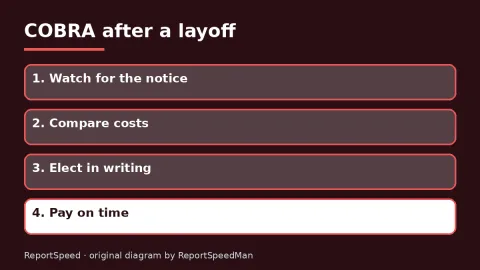
COBRA after a layoff: how long, how much and the deadlines
COBRA usually lasts 18 months, costs up to 102% of the premium, and gives you 60 days to elect and 45 days to pay.
Rate itSolved
Real experiences
No experiences yet. Be the first to share.