


I bought a used car from a private seller and have no idea whether it has any unfixed safety recalls. The seller didn't know either. How do I check for open recalls, and will I have to pay for the repair if there is one?
How do I check my car for open recalls by VIN?
Concerns & risks
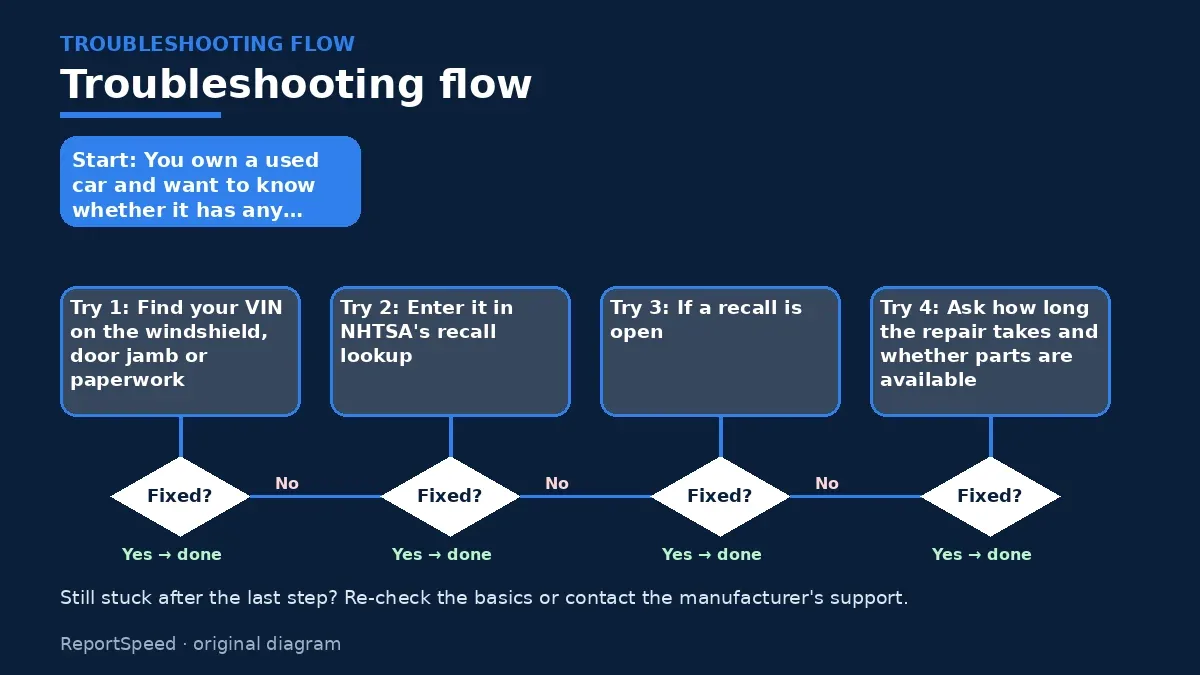
You own a used car and want to know whether it has any unrepaired safety recalls.
| Spot | Notes |
|---|---|
| Windshield | Lower left, driver side |
| Door jamb | Driver side sticker |
| Registration | Printed on the card |
| Insurance card | Usually listed |

Causes & evidence
NHTSA's recall lookup lets you enter your 17-character Vehicle Identification Number to see whether your vehicle has an open safety recall that hasn't been repaired. The VIN is usually on the lower left of the windshield, on the driver's side door jamb, and on your registration or insurance card. NHTSA says that when a recall is issued, manufacturers must fix the problem for free, typically by repair, replacement or in some cases a refund. Recall notices are mailed to the registered owner, so a second owner may never see one if the registration address is out of date. A recall that hasn't been issued yet won't show up, so it's worth checking again occasionally.
Recall lookups cover safety recalls from manufacturers. Some lookups may not include very recent recalls or every brand's records, so a dealer check can confirm.
Assuming a used car has no recalls because the last owner never mentioned any is a common and avoidable gap.
What to do
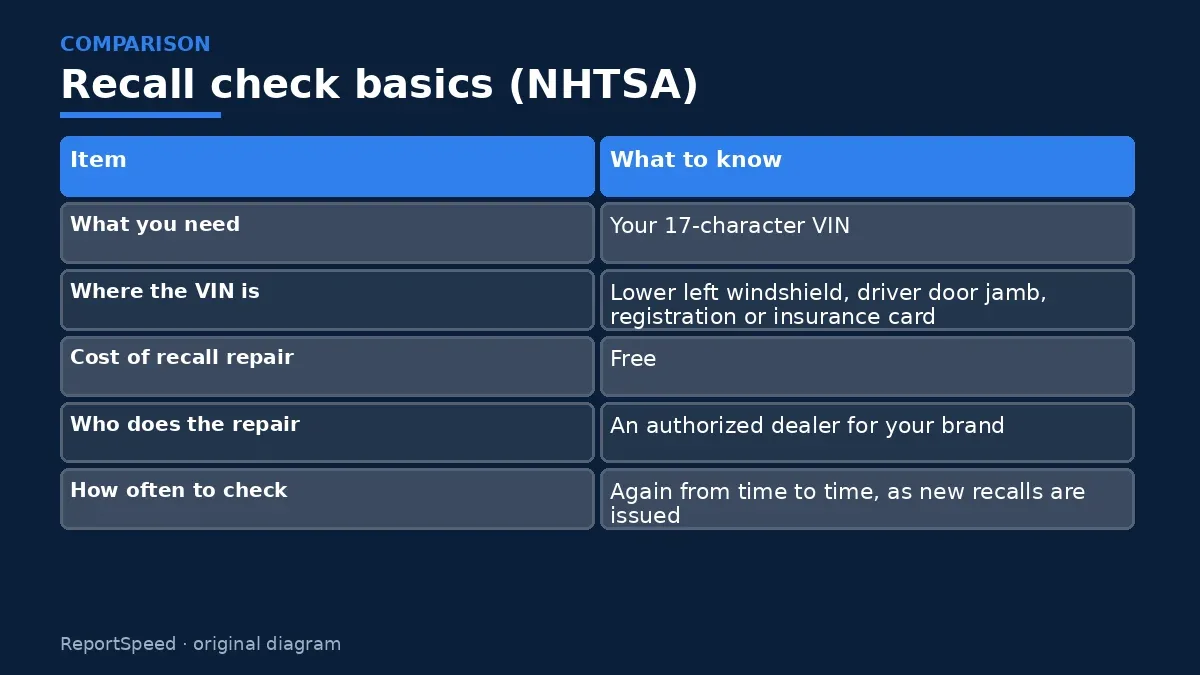
| Item | What to know |
|---|---|
| What you need | Your 17-character VIN |
| Where the VIN is | Lower left windshield, driver door jamb, registration or insurance card |
| Cost of recall repair | Free |
| Who does the repair | An authorized dealer for your brand |
| How often to check | Again from time to time, as new recalls are issued |
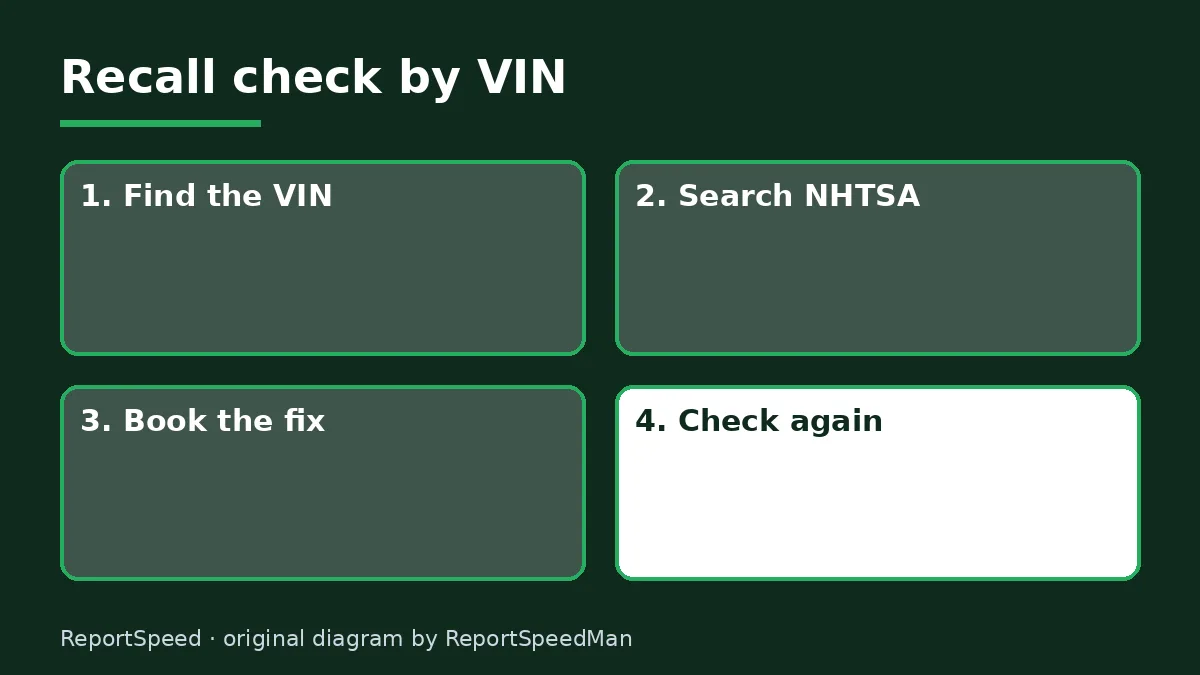
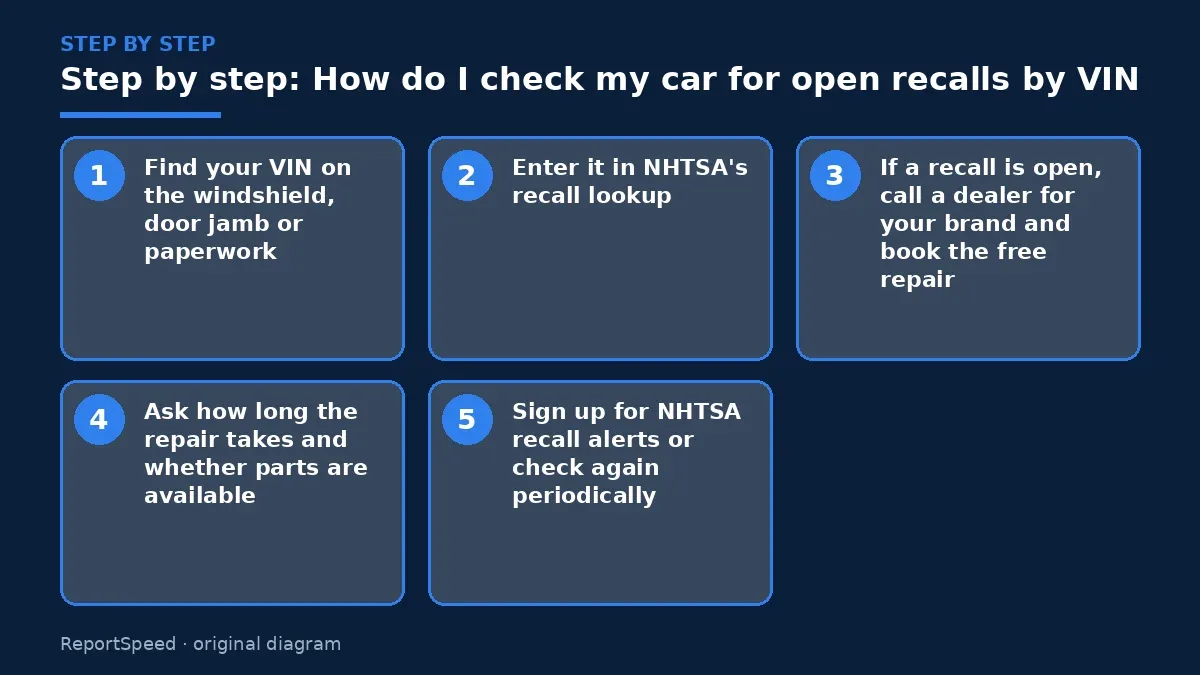
- Find your VIN on the windshield, door jamb or paperwork.
- Enter it in NHTSA's recall lookup.
- If a recall is open, call a dealer for your brand and book the free repair.
- Ask how long the repair takes and whether parts are available.
- Sign up for NHTSA recall alerts or check again periodically.
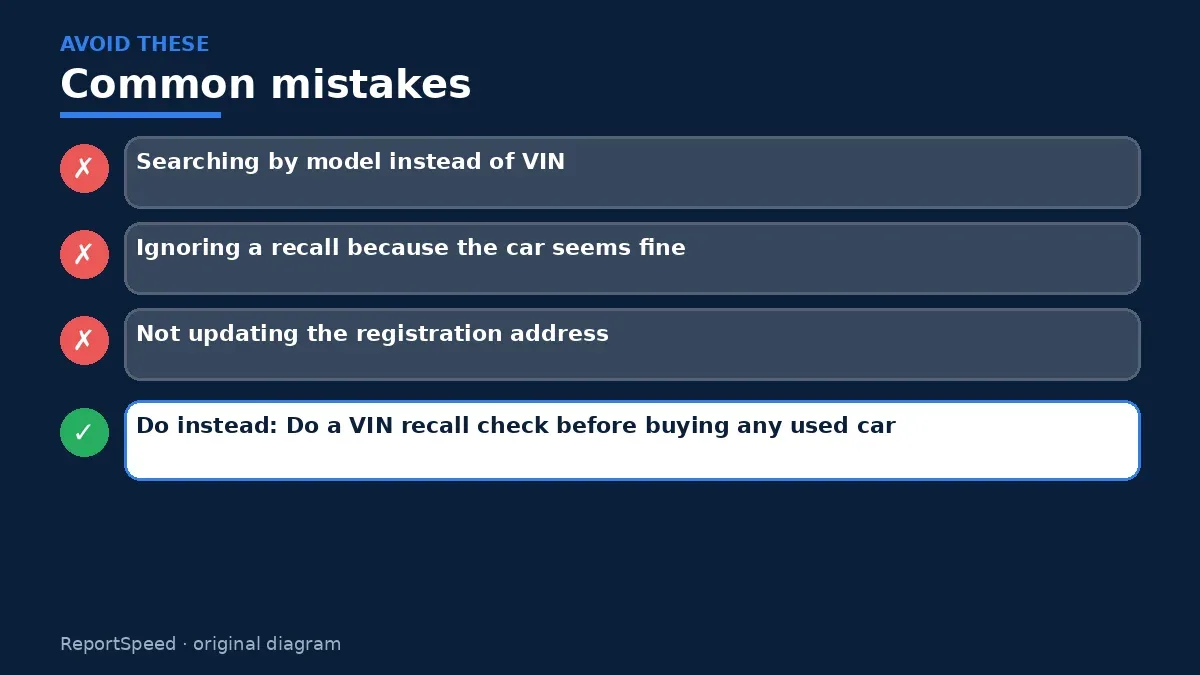
Common mistakes:
- Searching by model instead of VIN
- Ignoring a recall because the car seems fine
- Not updating the registration address
ReportSpeedMan tip: Do a VIN recall check before buying any used car. It's free and fits in a parking-lot test drive.
What I would actually do
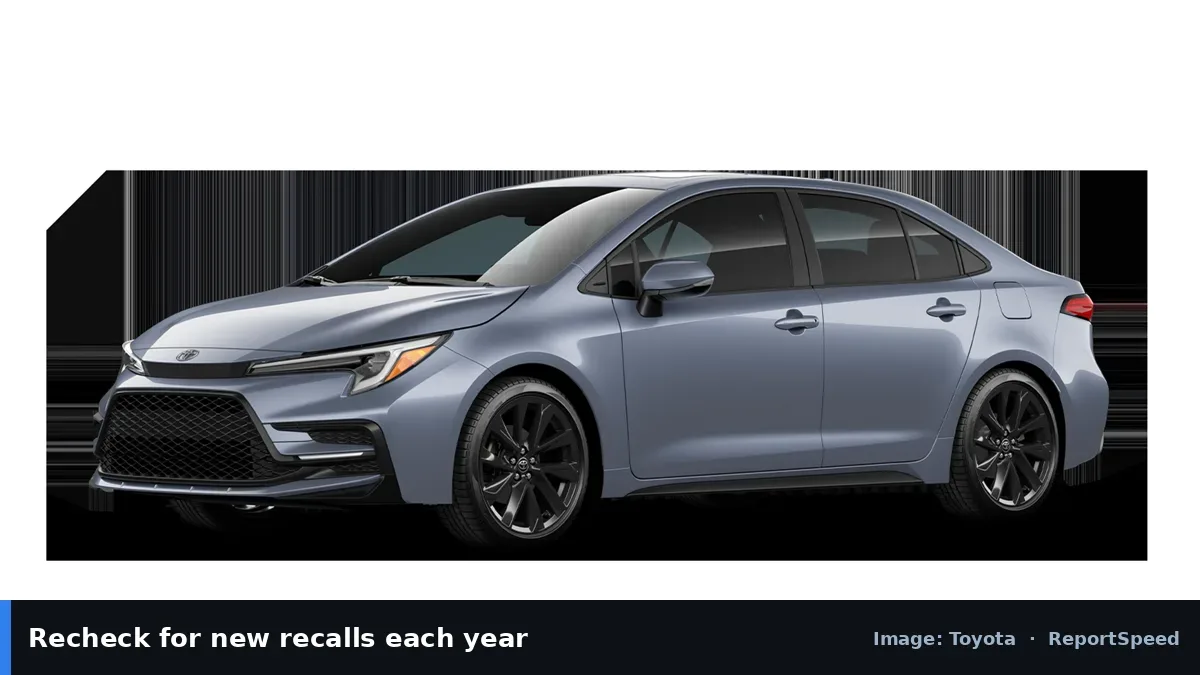
I'd check the VIN now, book any open recall, and set a reminder to recheck twice a year.
The trade-off people miss: parts for some recalls can be back-ordered, so getting on the dealer's list early can shorten the wait.
Signs it worked
The lookup shows no open recalls, or the dealer has completed the free repair.
Quick FAQ
Do I have to be the original owner?
No.
Is there a deadline for the free fix?
Rules vary; check with the dealer.
What about tires and car seats?
They have separate recall registration.
Wrap-up: Enter your VIN at NHTSA, book any open recall with a dealer and check again occasionally. It costs nothing and covers a real safety gap.
Wiki: Vehicle Recalls and Fuel Economy Basics.
How do I check my car for open recalls by VIN: official pages behind this answer
Step-by-step photos
1. Before The problem 
2. Why it happens The cause 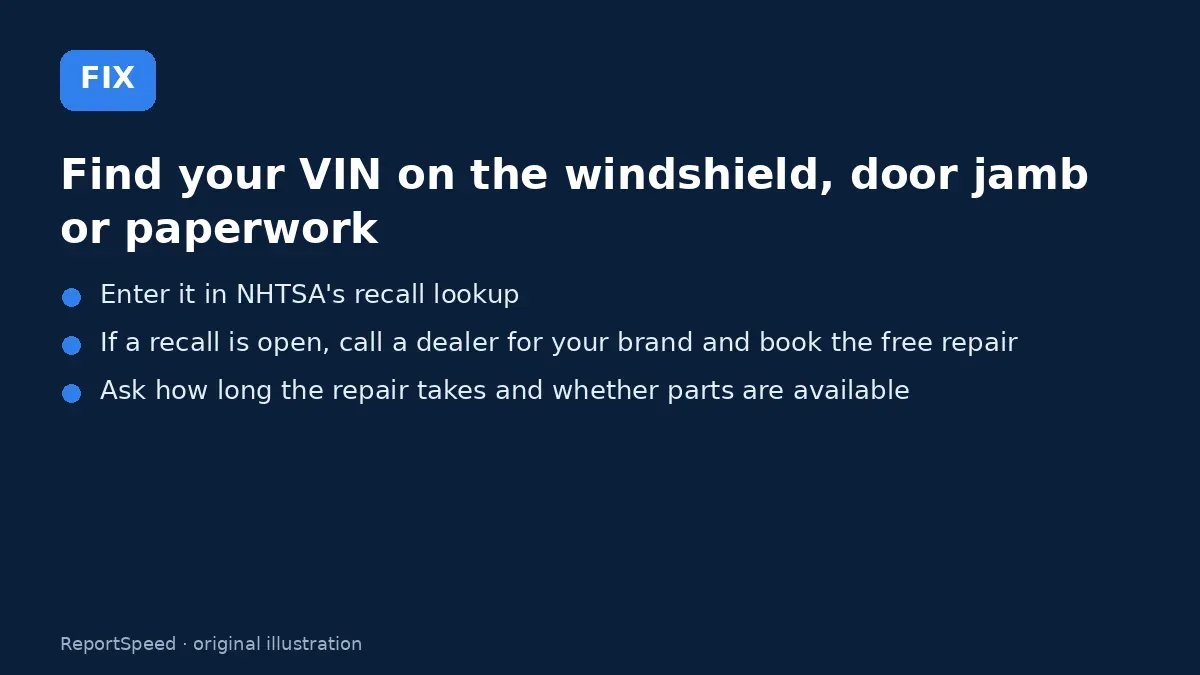
3. The fix The fix 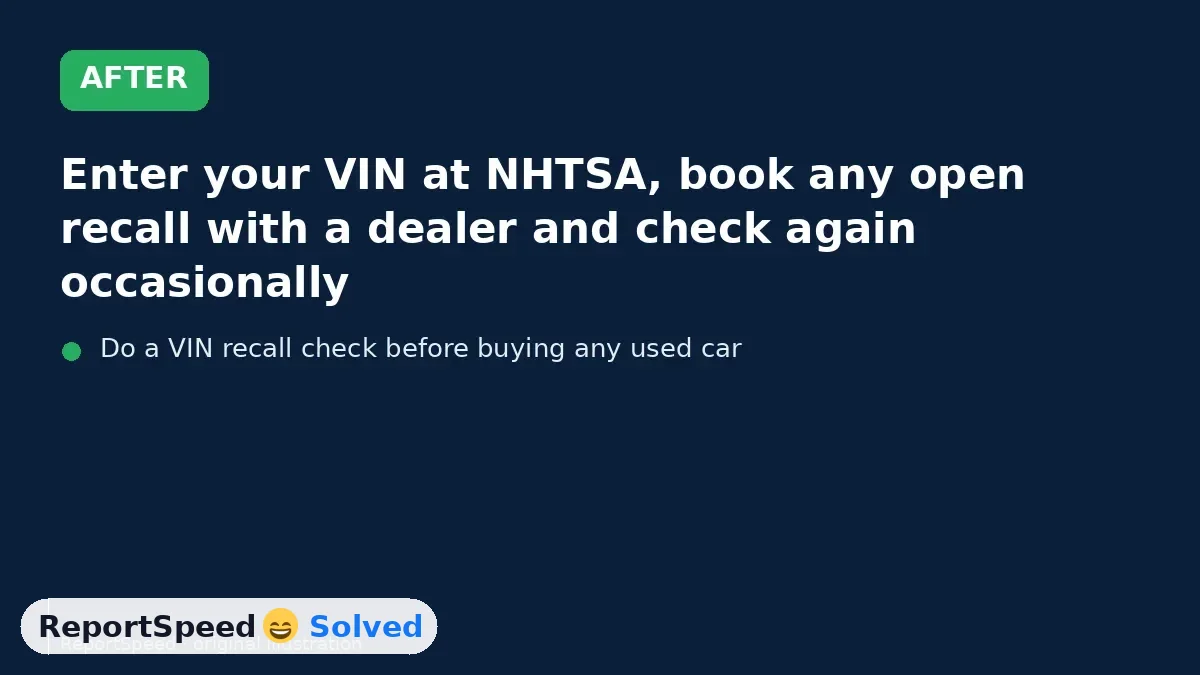
4. After The result
⚡ Speed Summary
- Enter your VIN at NHTSA, book any open recall with a dealer and check again occasionally.
- Do a VIN recall check before buying any used car. It's free and fits in a parking-lot test drive.
- Assuming a used car has no recalls because the last owner never mentioned any is a common and avoidable gap.

Was this answer helpful?
Tap a star to rate this answer.
Related questions

How far should I sit from the steering wheel airbag?
Keep 10 inches from the air bag cover, tilt the wheel toward your chest, and keep kids 12 and under in the back.
Rate itSolved
Is it safe to drive through a flooded road? How much water can float a car
Never drive into flood water; a foot of rushing water can carry most cars.
Rate itSolved
When can my child stop using a booster seat?
Keep the booster until the seat belt fits across the thighs and chest, and keep kids 12 and under in the back.
Rate itSolved
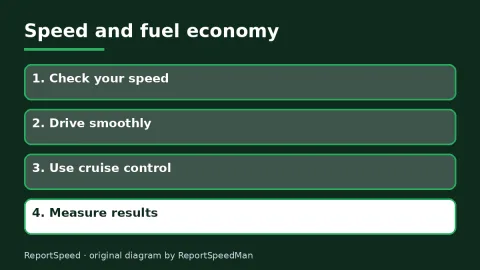
Does driving faster really waste gas? Speed and fuel economy
Above 50 mph mileage drops quickly, roughly like $0.30 more per gallon for each extra 5 mph.
Rate itSolved
Real experiences
No experiences yet. Be the first to share.