


I'm going back to work in a few weeks after having my baby and plan to keep breastfeeding. My office doesn't have a lactation room, and my manager suggested the restroom. What does the law actually require my employer to provide for pumping breaks and space?
Pumping at work: what breaks and space does my employer have to give?
Concerns & risks
You're returning to work while breastfeeding, there's no lactation room and your manager suggested the restroom.
| Request | Note |
|---|---|
| Private space | Not a bathroom |
| Lockable or shielded | Free from intrusion |
| Break schedule | As often as needed |
| Fridge or storage | Ask; helpful to have |

Causes & evidence
The PUMP for Nursing Mothers Act, enforced by the Department of Labor, requires most employers to provide reasonable break time for an employee to express breast milk each time she needs to, for one year after the child's birth. Employers must also provide a place, other than a bathroom, that is shielded from view and free from intrusion by coworkers and the public. Break time must be paid if the employee isn't completely relieved from duty, or if the employer already provides paid breaks and she uses them to pump. Employers with fewer than 50 employees can be exempt only if compliance would cause undue hardship. Before filing a lawsuit for a space violation, employees generally must notify the employer and allow 10 days to fix it, with some exceptions.
Some states provide stronger protections than federal law. Airline flight crew and some other groups have special rules.
Accepting a restroom as your pumping space when the law requires a non-bathroom space can make pumping harder and isn't required of you.
What to do
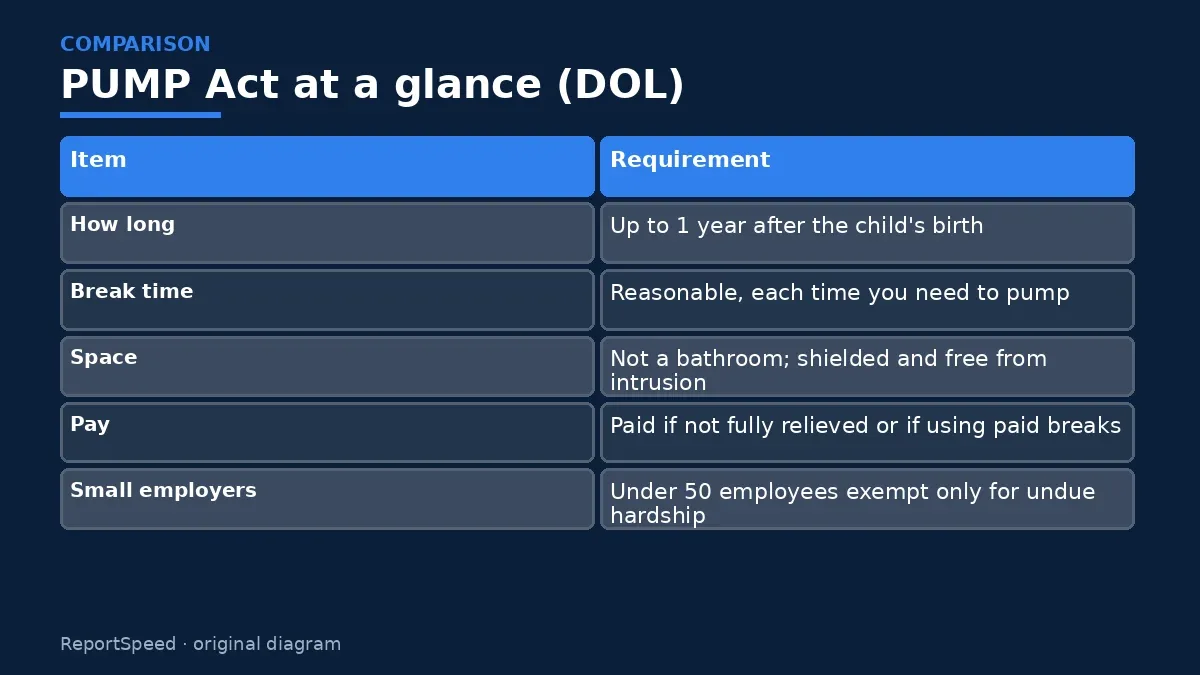
| Item | Requirement |
|---|---|
| How long | Up to 1 year after the child's birth |
| Break time | Reasonable, each time you need to pump |
| Space | Not a bathroom; shielded and free from intrusion |
| Pay | Paid if not fully relieved or if using paid breaks |
| Small employers | Under 50 employees exempt only for undue hardship |
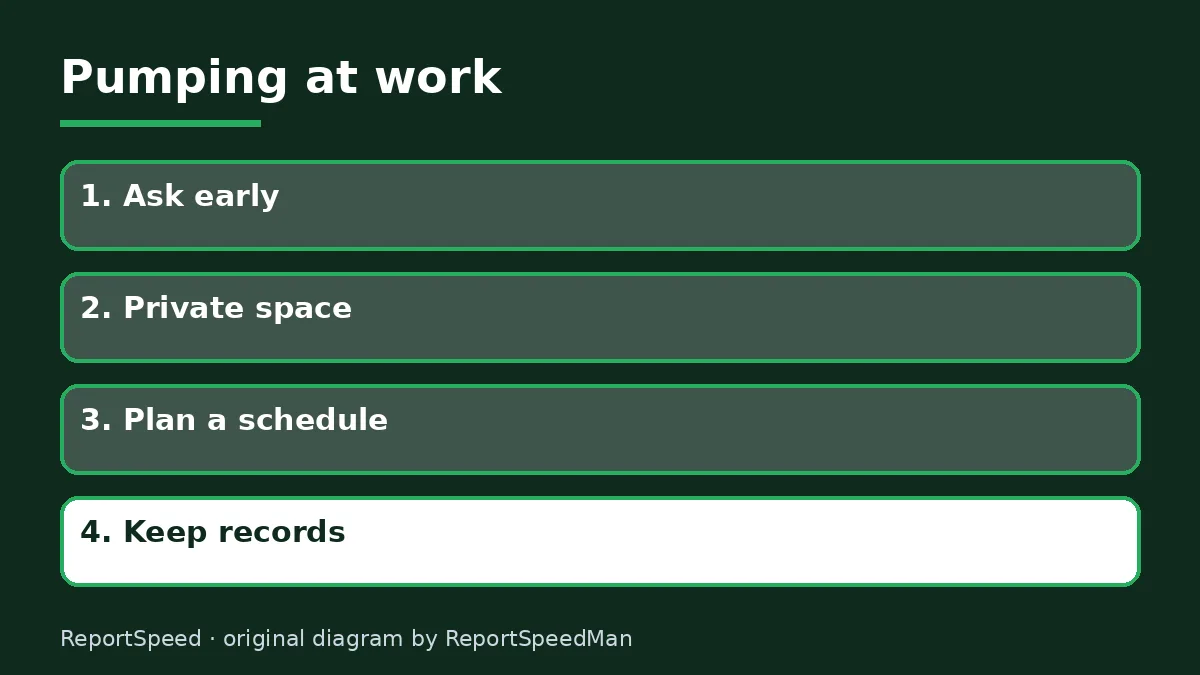
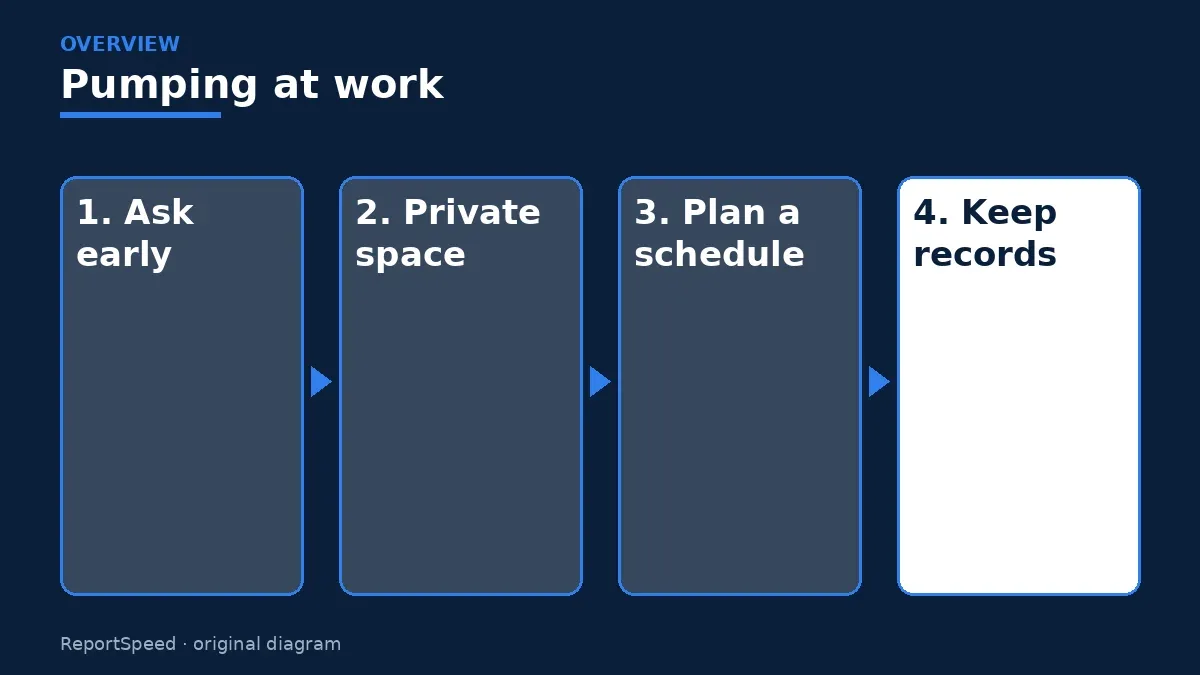
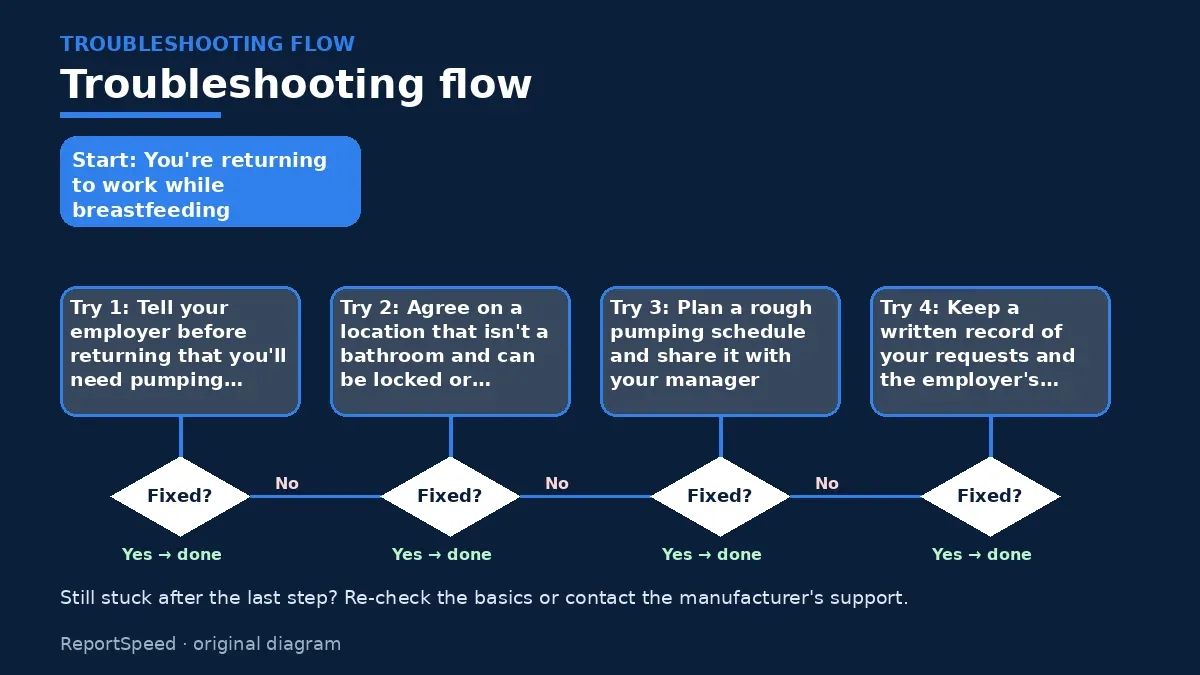
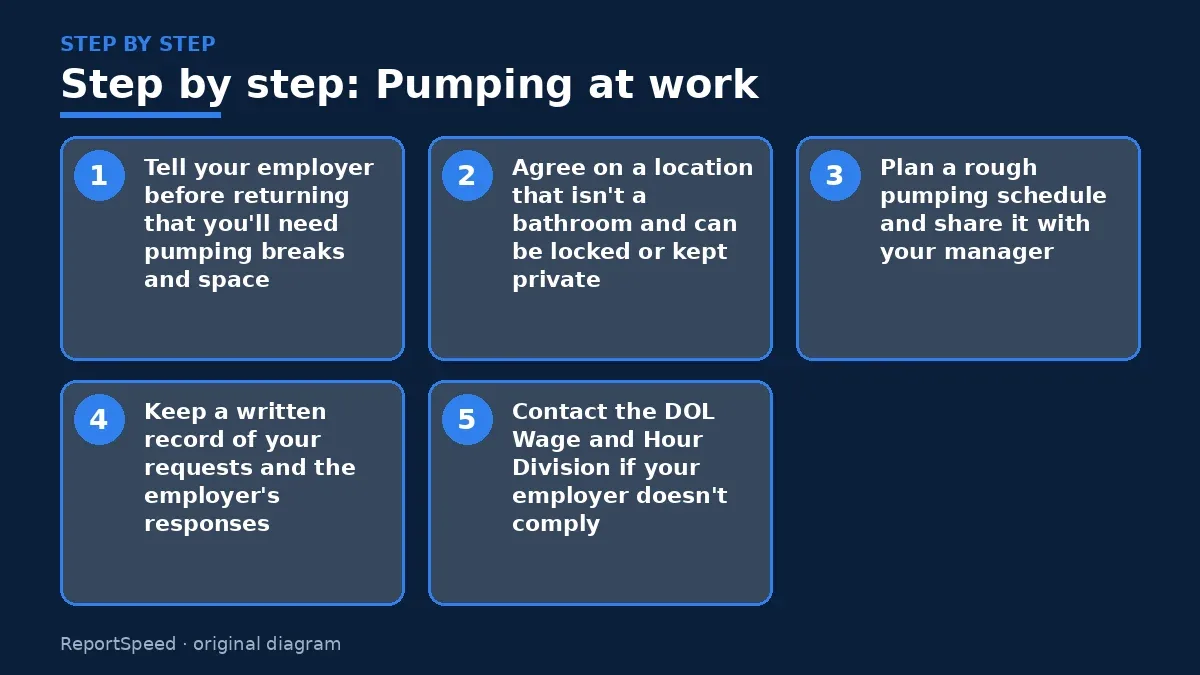
- Tell your employer before returning that you'll need pumping breaks and space.
- Agree on a location that isn't a bathroom and can be locked or kept private.
- Plan a rough pumping schedule and share it with your manager.
- Keep a written record of your requests and the employer's responses.
- Contact the DOL Wage and Hour Division if your employer doesn't comply.
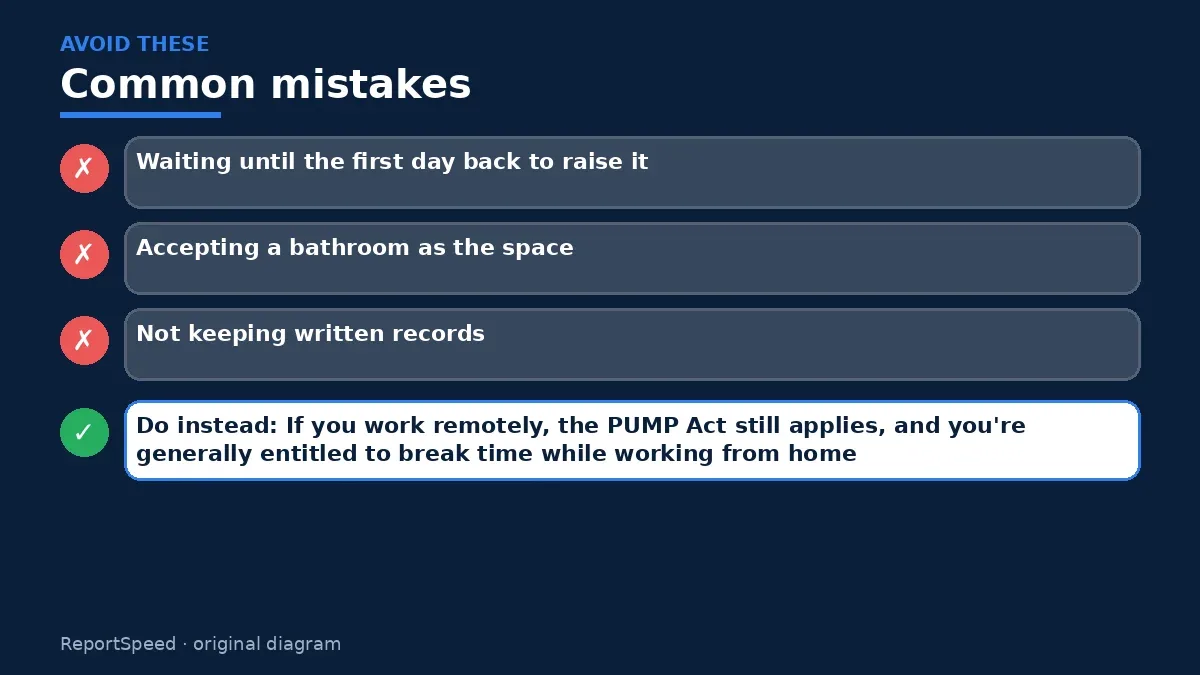
Common mistakes:
- Waiting until the first day back to raise it
- Accepting a bathroom as the space
- Not keeping written records
ReportSpeedMan tip: If you work remotely, the PUMP Act still applies, and you're generally entitled to break time while working from home.
What I would actually do
I'd email my manager two weeks before returning, ask for a specific private space and a schedule, and keep that email.
The trade-off people miss: pumping breaks may be unpaid if you're fully relieved of duty and not using paid breaks, so plan your schedule with that in mind.
Signs it worked
You have a private, non-bathroom space and an agreed break schedule.
Quick FAQ
Does it apply to remote work?
Yes, generally.
Can my employer require a schedule?
You can agree on one, but needs may vary.
What if there's no room?
A temporary private space can qualify.
Wrap-up: Ask early, insist on a private non-bathroom space and keep a record. The law is on your side for the first year after birth.
Wiki: Wage and Hour Basics (FLSA) and Sleep Basics and Insomnia.
Pumping at work: read the originals
Step-by-step photos
1. Before The problem 
2. Why it happens The cause 
3. The fix The fix 
4. After The result
⚡ Speed Summary
- Ask early, insist on a private non-bathroom space and keep a record.
- If you work remotely, the PUMP Act still applies, and you're generally entitled to break time while working from home.
- Accepting a restroom as your pumping space when the law requires a non-bathroom space can make pumping harder and isn't required of you.

Was this answer helpful?
Tap a star to rate this answer.
Related questions
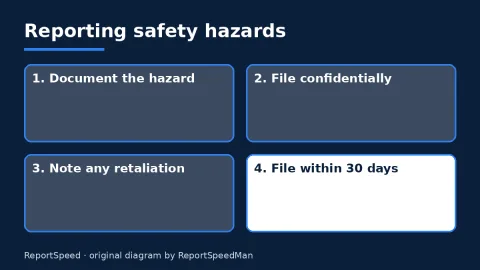
Can I be fired for reporting a safety problem at work? OSHA's 30-day rule
You can report hazards confidentially, and retaliation is illegal.
Rate itSolved

Pregnant at work: what accommodations can I ask for under the PWFA?
Under the PWFA, employers with 15+ workers must reasonably accommodate pregnancy limitations.
Rate itSolved
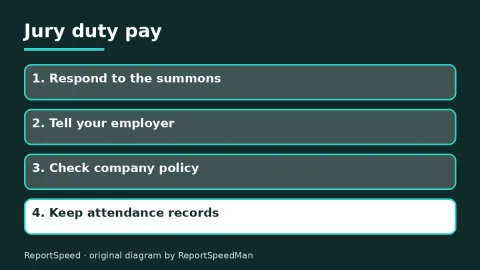
Do I get paid for jury duty, and can my employer fire me for going?
Federal jurors earn $50 a day; employer pay is optional, but firing you for federal jury service is illegal.
Rate itSolved
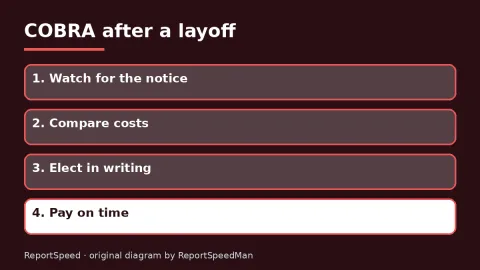
COBRA after a layoff: how long, how much and the deadlines
COBRA usually lasts 18 months, costs up to 102% of the premium, and gives you 60 days to elect and 45 days to pay.
Rate itSolved
Real experiences
No experiences yet. Be the first to share.