


I finally have a little money left over each month and want to start retirement savings outside work. Every article says open an IRA, but then splits into Roth versus traditional and I get lost in the tax talk. I'm in my late twenties with an average salary. Which one should I open first, and does it even matter that much?
Roth IRA vs traditional IRA: which should I open first?
Concerns & risks
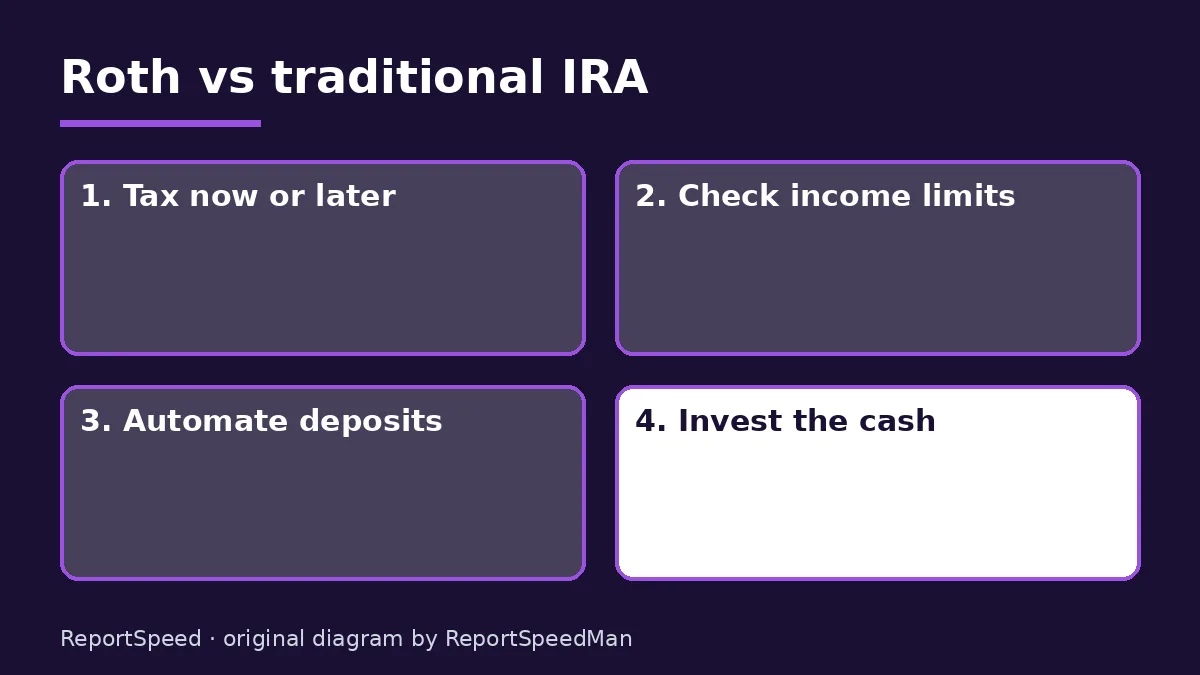
You have spare cash, you have heard IRAs are smart, and the Roth versus traditional debate is the only thing stopping you from actually opening one.
| If this sounds like you… | Often leans |
|---|---|
| Early career, expect higher income later | Roth |
| High earner now, want a deduction | Traditional (check deduction rules) |
| Unsure about future tax rates | Split between both within the limit |
| Income above Roth limits | Check IRS rules before contributing |

Causes & evidence
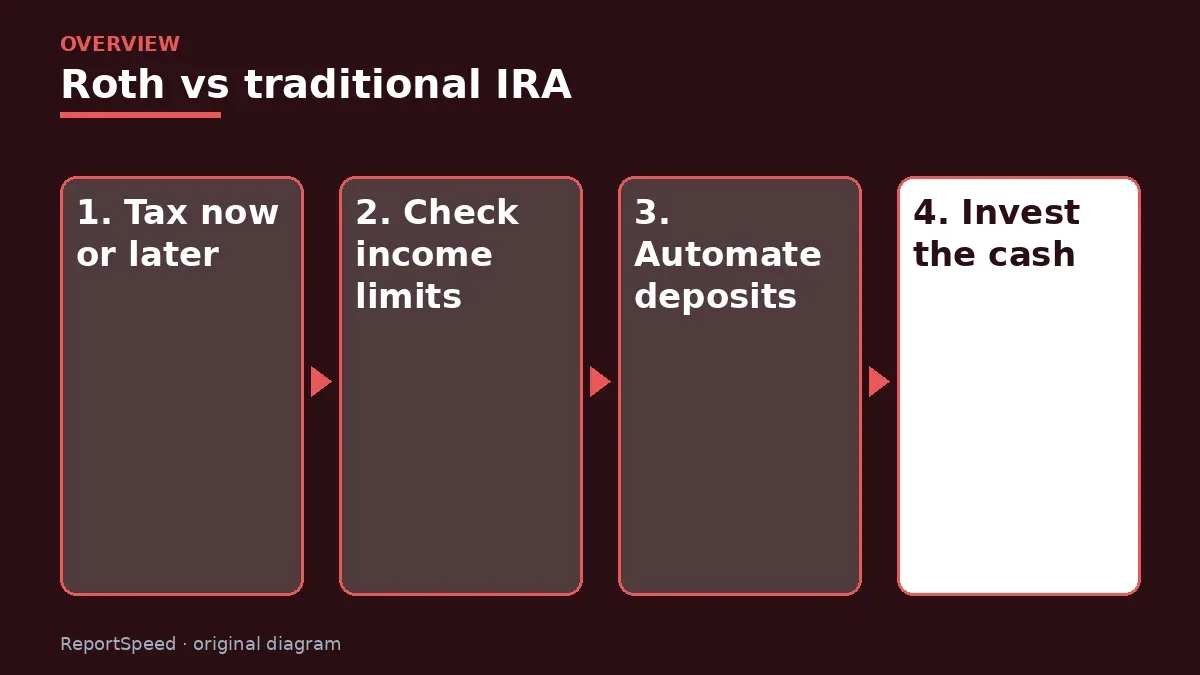
The IRS treats the two accounts as mirror images. Traditional IRA contributions may be tax-deductible now, depending on your income and whether you have a workplace plan, and withdrawals in retirement are taxed as income. Roth IRA contributions are made with after-tax money, and qualified withdrawals later are tax-free. For 2026 the IRS caps total contributions across all your traditional and Roth IRAs at $7,500, or $8,600 if you are 50 or older, and Roth eligibility phases out at higher incomes. So the question is really about your tax rate today versus what you expect in retirement.
The IRS lets you contribute to both types in the same year as long as the combined total stays within the limit. Roth eligibility depends on modified adjusted gross income, and traditional IRA deductibility can depend on whether you or a spouse have a workplace plan.
Waiting a year to 'decide properly' usually costs more in missed growth than picking the slightly less ideal account would.
What to do
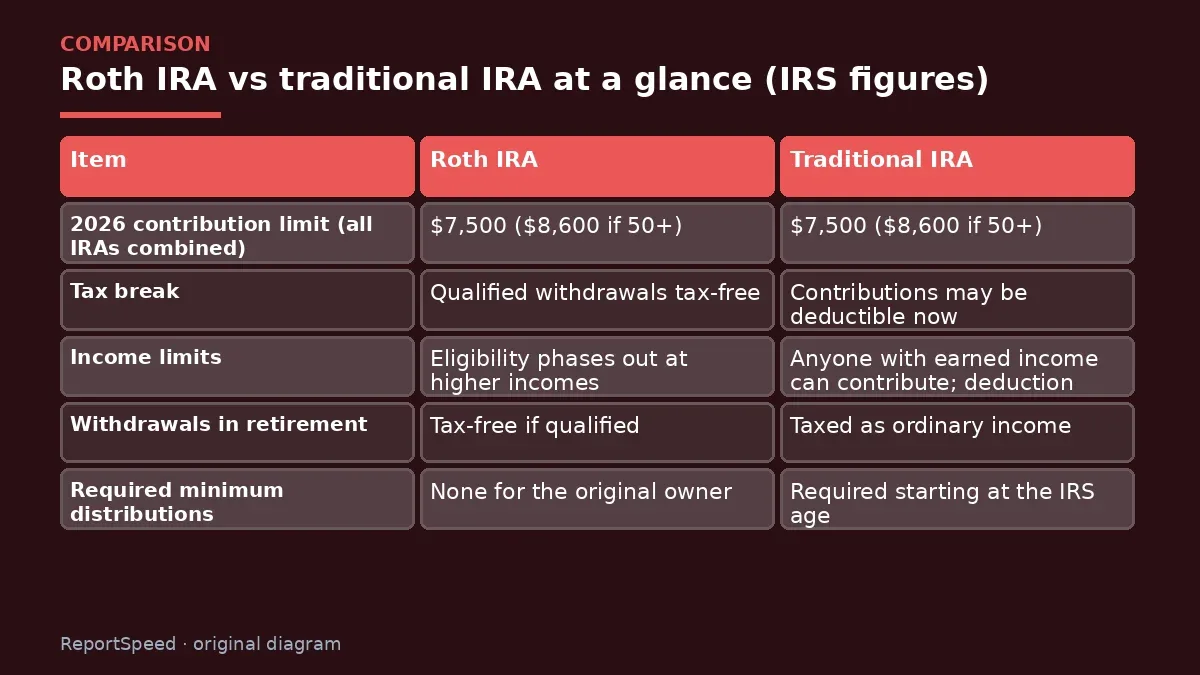
| Item | Roth IRA | Traditional IRA |
|---|---|---|
| 2026 contribution limit (all IRAs combined) | $7,500 ($8,600 if 50+) | $7,500 ($8,600 if 50+) |
| Tax break | Qualified withdrawals tax-free | Contributions may be deductible now |
| Income limits | Eligibility phases out at higher incomes | Anyone with earned income can contribute; deduction may phase out |
| Withdrawals in retirement | Tax-free if qualified | Taxed as ordinary income |
| Required minimum distributions | None for the original owner | Required starting at the IRS age |
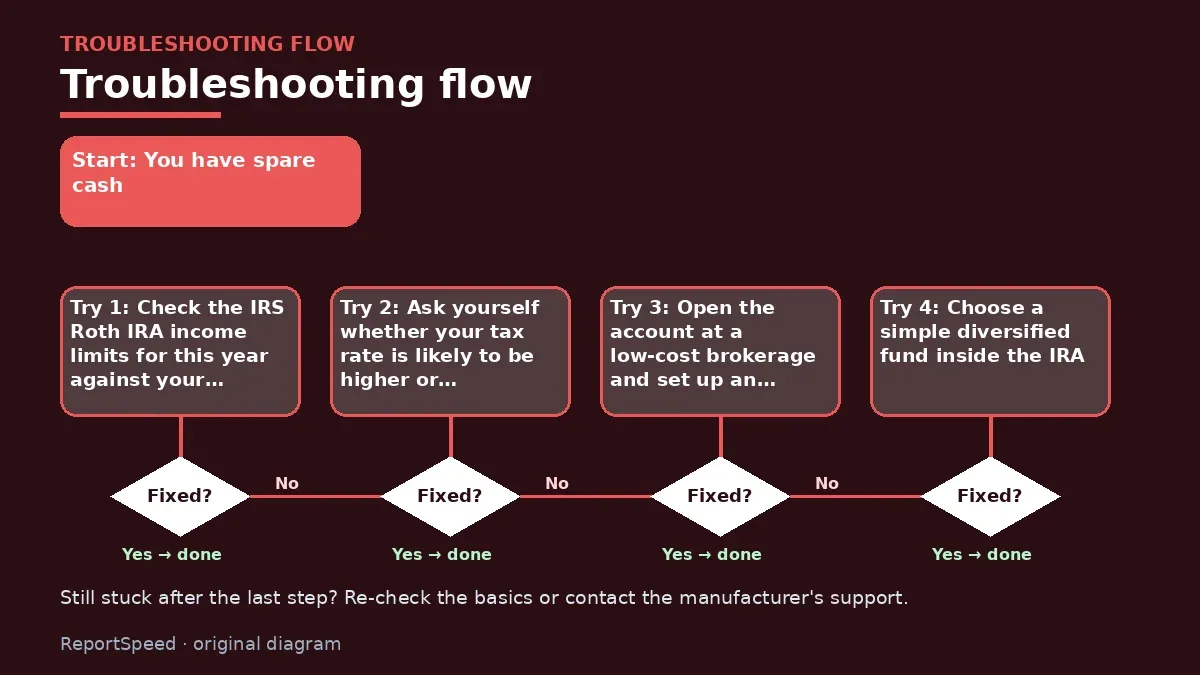
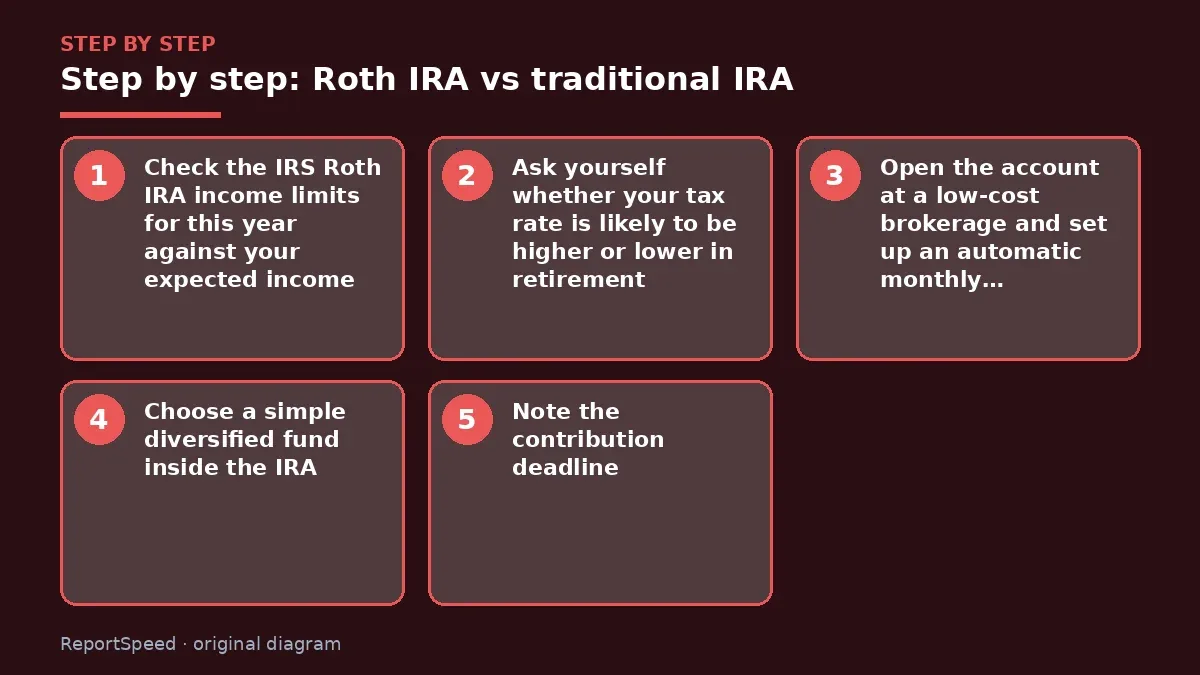
- Check the IRS Roth IRA income limits for this year against your expected income.
- Ask yourself whether your tax rate is likely to be higher or lower in retirement.
- Open the account at a low-cost brokerage and set up an automatic monthly transfer.
- Choose a simple diversified fund inside the IRA, since cash sitting there earns little.
- Note the contribution deadline, which is usually the tax filing date for the prior year.
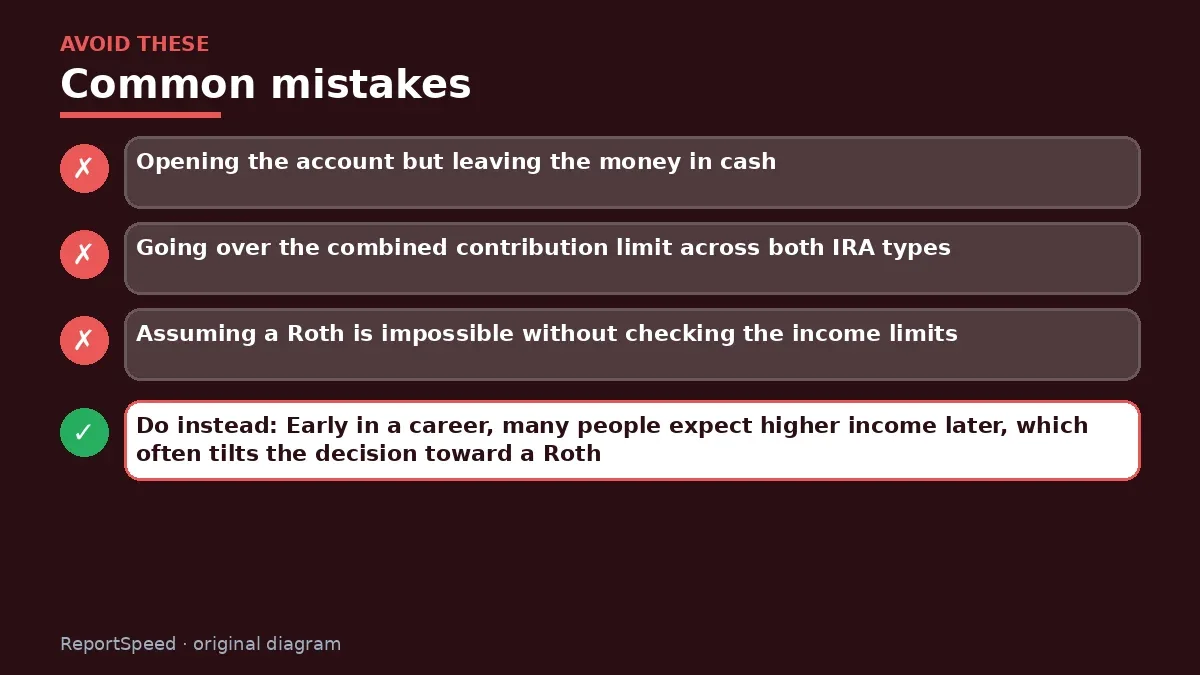
Common mistakes:
- Opening the account but leaving the money in cash
- Going over the combined contribution limit across both IRA types
- Assuming a Roth is impossible without checking the income limits
ReportSpeedMan tip: Early in a career, many people expect higher income later, which often tilts the decision toward a Roth. If you are unsure, splitting contributions between both is allowed as long as the total stays within the limit.
What I would actually do

early in a career I'd open a Roth IRA, automate a monthly amount I won't miss and invest it in a broad index fund. If my income later rose past the Roth limits, I'd revisit with the IRS rules in hand.
The trade-off people miss: the tax choice matters less than the habit. A traditional IRA funded every month beats a perfect Roth that never gets money.
How to tell it worked
Your IRA is open, a monthly transfer runs automatically and the money is invested, not sitting in cash.
Quick FAQ
Can I have both?
Yes, but the combined contribution limit applies across all your IRAs.
Can I withdraw Roth contributions?
Contributions generally can be withdrawn, but earnings have rules; check IRS guidance.
When is the deadline?
Usually the tax filing deadline for the prior year.
Wrap-up: Pick the account that matches your tax picture, automate the deposits and invest the money. Starting matters more than perfection.
Wiki: Compound Interest and Emergency Fund.
Roth IRA vs traditional IRA: where the facts come from
Step-by-step photos

1. Before The problem 
2. Why it happens The cause 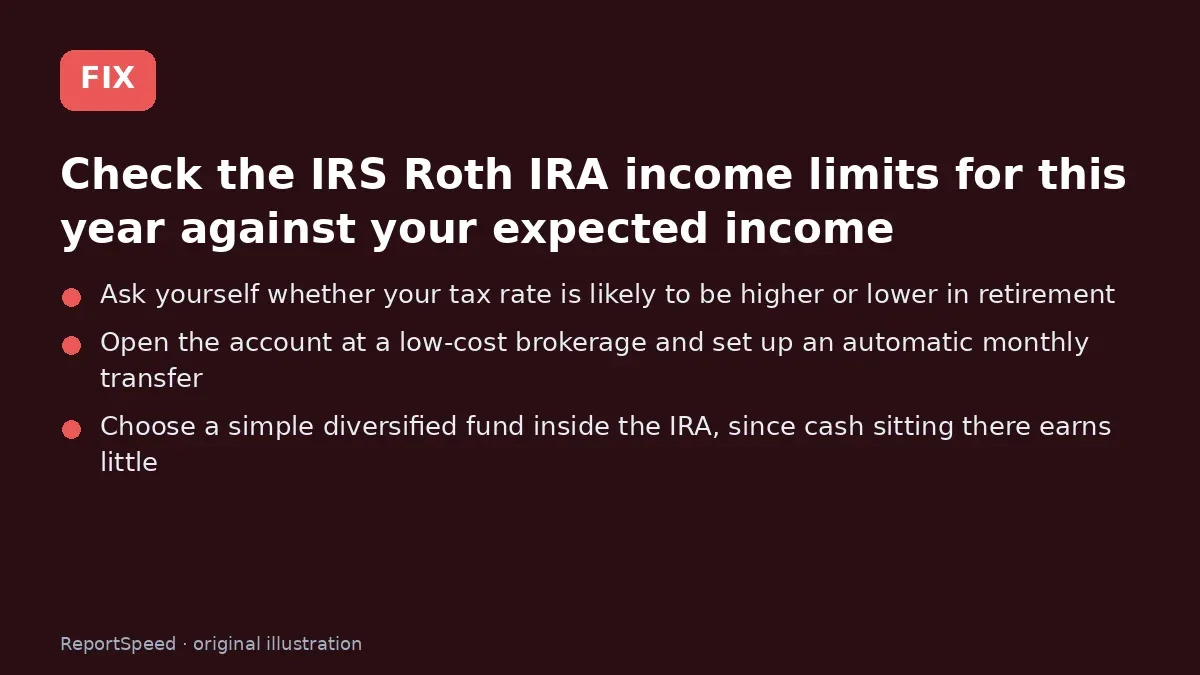
3. The fix The fix 
4. After The result
⚡ Speed Summary
- Pick the account that matches your tax picture, automate the deposits and invest the money.
- Early in a career, many people expect higher income later, which often tilts the decision toward a Roth. If you are unsure, splitting contributions between both is allowed as long as the total stays w
- Waiting a year to 'decide properly' usually costs more in missed growth than picking the slightly less ideal account would.

Was this answer helpful?
Tap a star to rate this answer.
Related questions
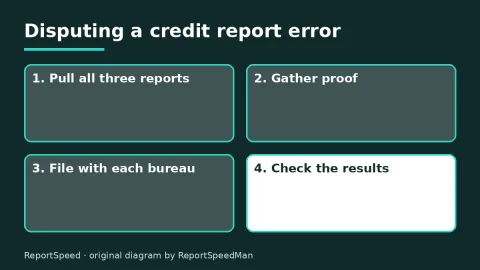
Found an error on my credit report? How to dispute it step by step
Dispute with each bureau and the furnisher, include proof, and expect results in about 30 days.
Rate itSolved
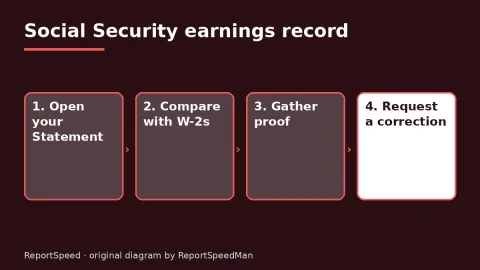
How do I check my Social Security earnings record and fix a mistake?
Check your Statement every year, match it to your W-2s, and correct gaps with proof before the usual window closes.
Rate itSolved
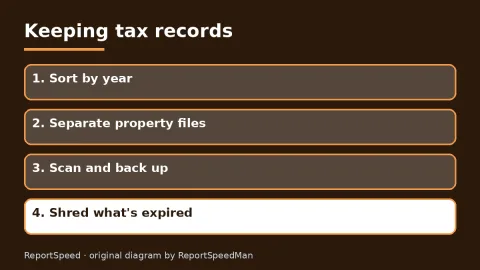
How long should I keep tax records? The IRS 3-, 6- and 7-year rules
Three years covers most returns; six, seven or forever apply in specific cases.
Rate itSolved
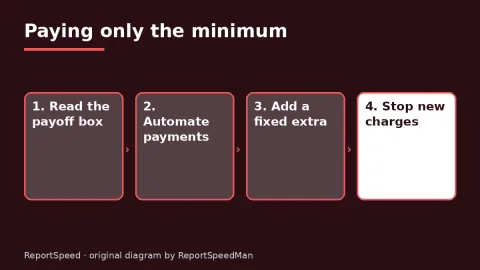
What happens if I only pay the minimum on my credit card?
Minimum payments keep you current but stretch the debt for years.
Rate itSolved
Real experiences
No experiences yet. Be the first to share.