


My aunt said she found $220 from an old utility deposit in a state unclaimed property database. I've moved between three states and changed banks a few times. I also got a letter from a company offering to recover 'lost funds' for a 30% fee. How do I find unclaimed money in my name for free, and is that letter worth answering?
How do I find unclaimed money in my name for free?

Concerns & risks
You've lived in three states, switched banks, and received a letter offering paid recovery of lost funds.
| Item | Why |
|---|---|
| Photo ID | Proves identity |
| Past addresses | Matches the record |
| Former names | Finds older records |
| SSN (on official site only) | Some states require it |
| Proof of ownership | Statements or letters if asked |
| Heirs' documents | Death certificate, estate papers |

Causes & evidence
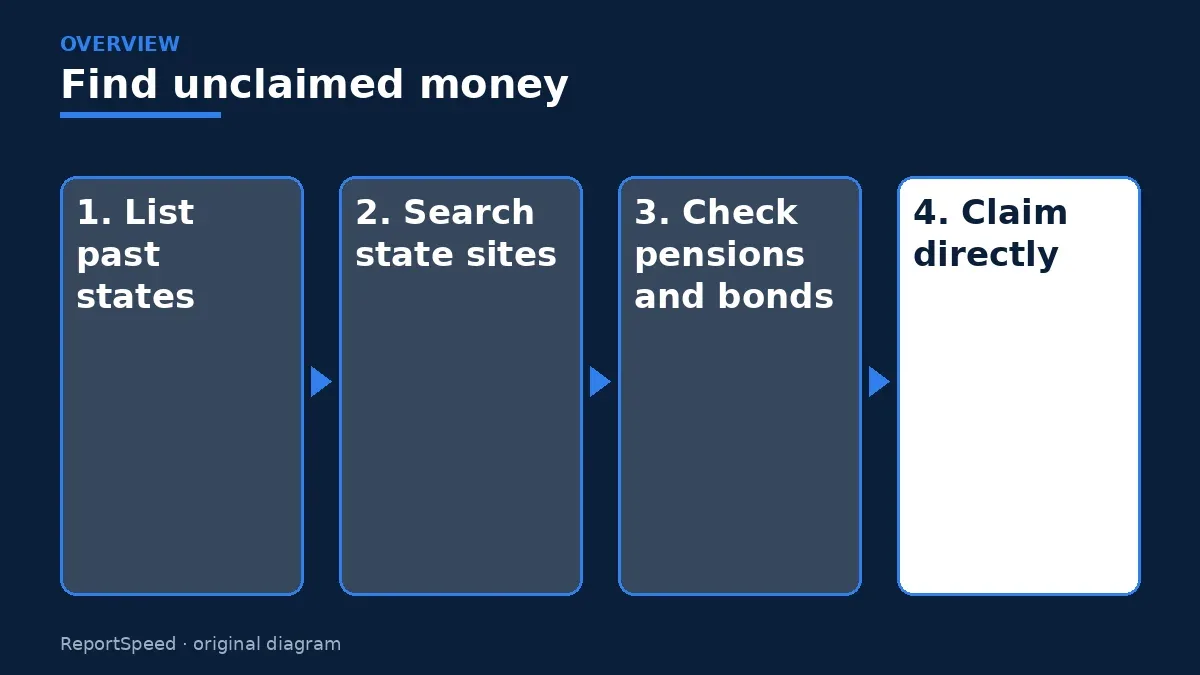
USA.gov explains that state governments hold most unclaimed money, such as forgotten bank accounts, uncashed checks, insurance payouts, utility deposits and refunds. You search each state's unclaimed property office, including every state where you've lived or done business. Some money sits with federal agencies instead: the Pension Benefit Guaranty Corporation has a search for unclaimed pensions from former employers, TreasuryDirect handles matured savings bonds, and the IRS handles undelivered refunds. USA.gov says searching government databases is free. Companies that send 'asset recovery' letters may be legitimate but charge for something you can do yourself, and scammers also imitate these offers to collect fees or personal details.
Who this applies to: anyone, including heirs. If the money belonged to a relative who died, states have claim processes for heirs, usually requiring a death certificate and estate documents. Some states pay small claims quickly online; larger ones may need notarized forms.
Signing a finder's contract before doing a five-minute free search can cost you a third of money that was already yours.
What to do
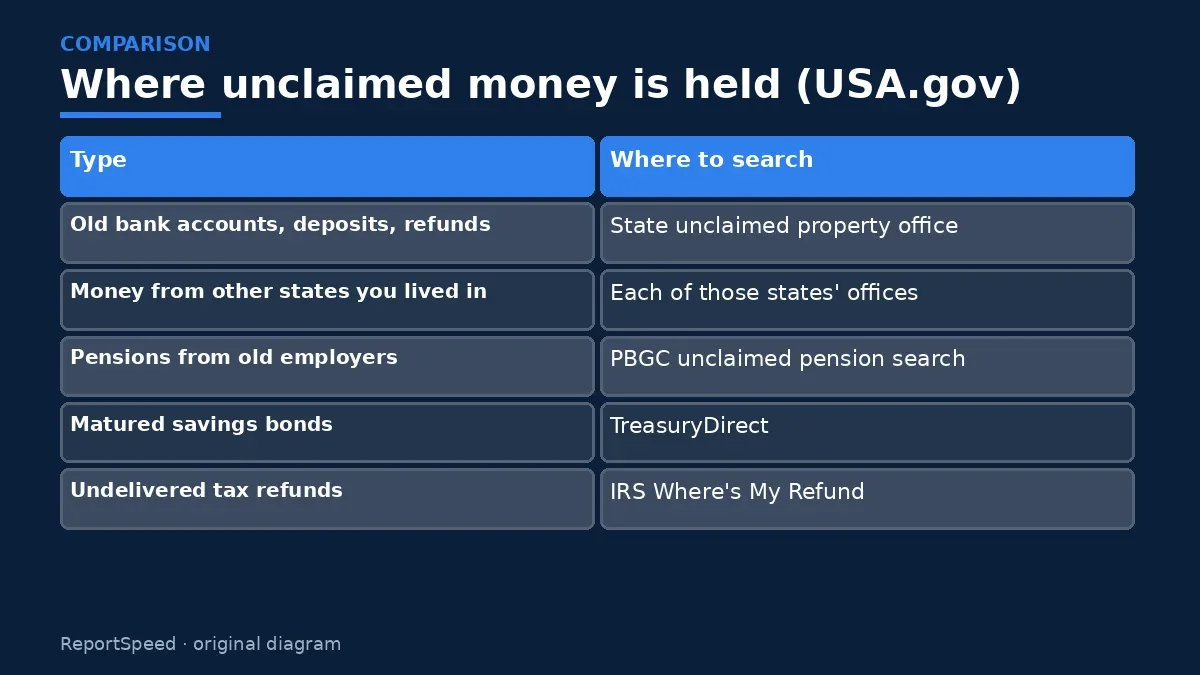
| Type | Where to search |
|---|---|
| Old bank accounts, deposits, refunds | State unclaimed property office |
| Money from other states you lived in | Each of those states' offices |
| Pensions from old employers | PBGC unclaimed pension search |
| Matured savings bonds | TreasuryDirect |
| Undelivered tax refunds | IRS Where's My Refund |
| Cost of government search | Free |
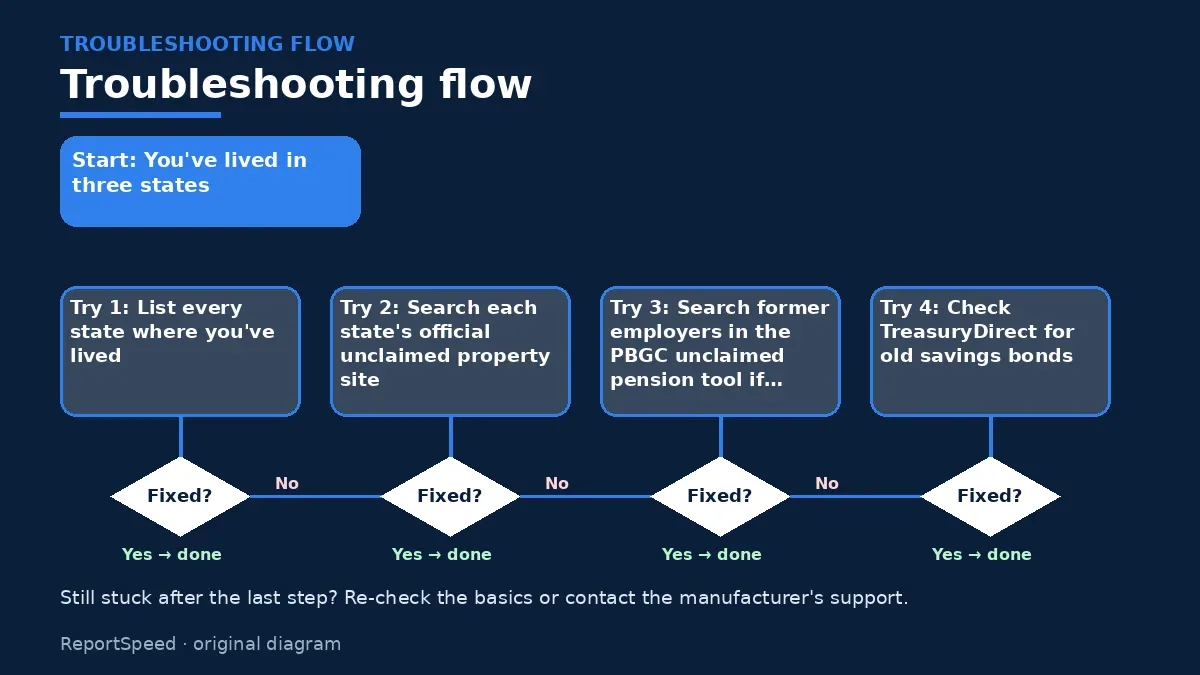
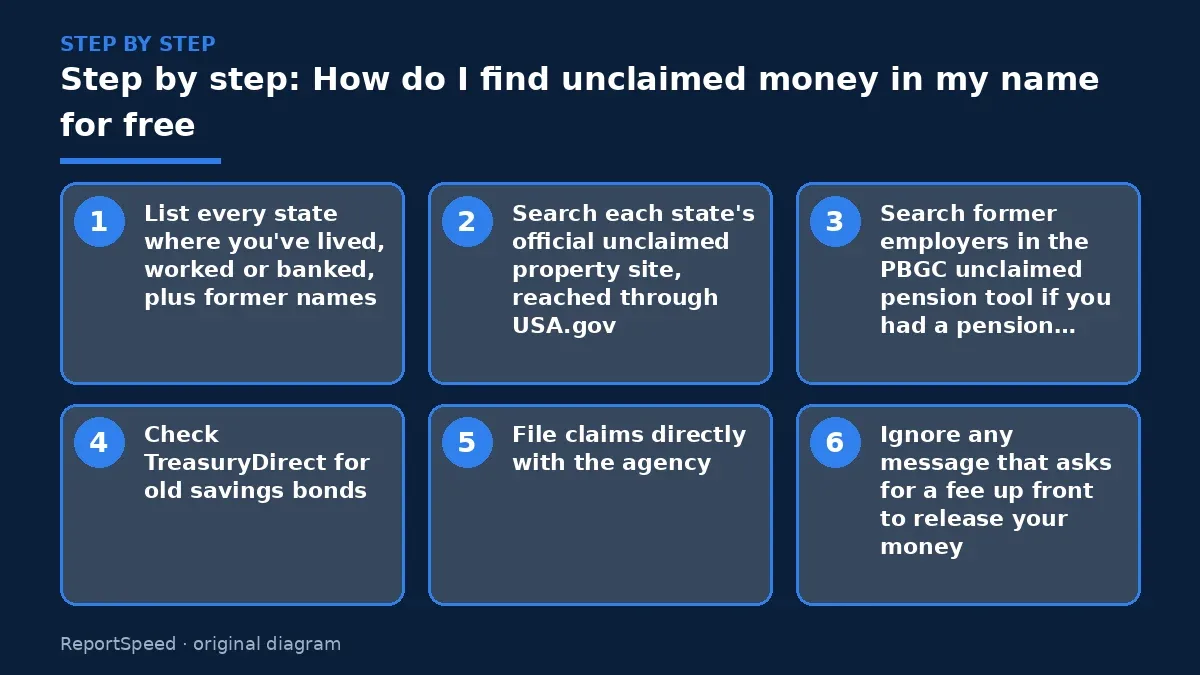
- List every state where you've lived, worked or banked, plus former names.
- Search each state's official unclaimed property site, reached through USA.gov.
- Search former employers in the PBGC unclaimed pension tool if you had a pension plan.
- Check TreasuryDirect for old savings bonds.
- File claims directly with the agency, uploading ID and proof of address as requested.
- Ignore any message that asks for a fee up front to release your money.
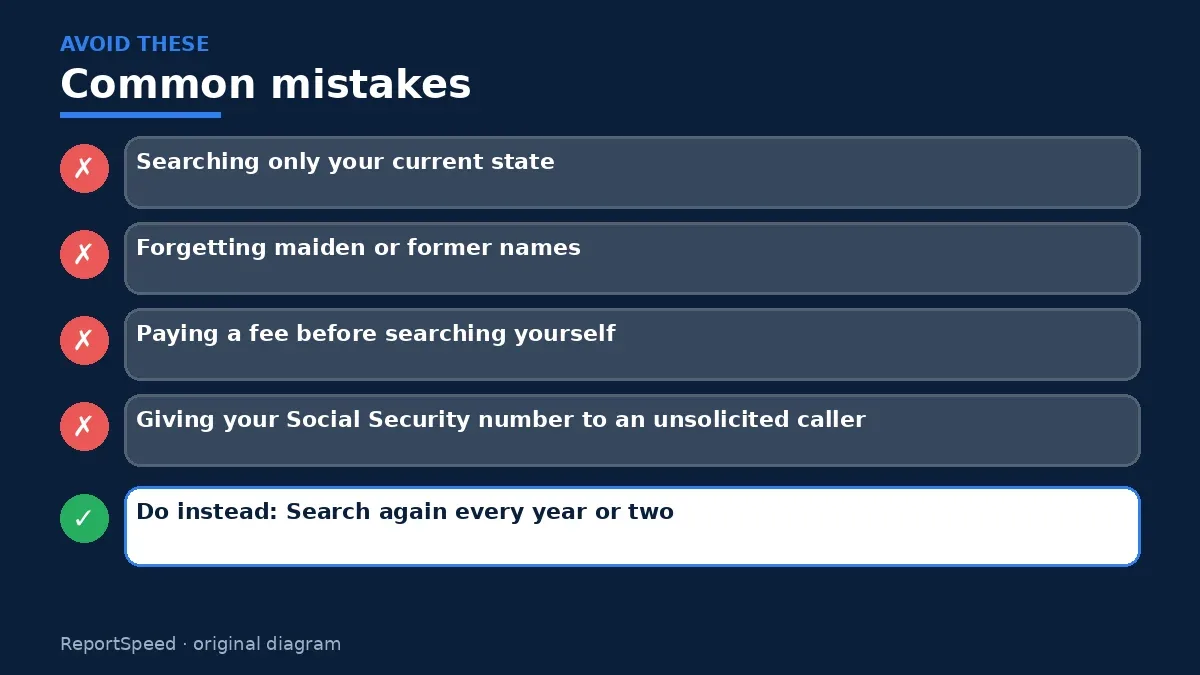
Common mistakes:
- Searching only your current state
- Forgetting maiden or former names
- Paying a fee before searching yourself
- Giving your Social Security number to an unsolicited caller
ReportSpeedMan tip: Search again every year or two. New property gets reported to states regularly, so a blank result today doesn't mean blank forever.
What I would actually do
I'd spend 20 minutes searching every state I've lived in, plus the PBGC and TreasuryDirect, and set a reminder to repeat it next year.
The trade-off people miss: finder companies sometimes locate money you'd struggle to find, but most claims are simple. Paying a percentage only makes sense after you've tried the free tools.
Signs it worked
You've searched every state you've lived in and filed any claims directly.
Quick FAQ
Is searching free?
Yes, on official government sites.
What about finder letters?
They may charge a percentage; search yourself first.
How often should I check?
Every year or two.
Wrap-up: Search every state you've lived in plus the PBGC and TreasuryDirect tools, claim directly, and skip the finder's fee.
Wiki: Identity Theft Recovery Steps and Emergency Fund.
How do I find unclaimed money in my name for free: read the originals
Step-by-step photos

1. Before The problem 
2. Why it happens The cause 
3. The fix The fix 
4. After The result
⚡ Speed Summary
- Search every state you've lived in plus the PBGC and TreasuryDirect tools, claim directly, and skip the finder's fee.
- Search again every year or two. New property gets reported to states regularly, so a blank result today doesn't mean blank forever.
- Signing a finder's contract before doing a five-minute free search can cost you a third of money that was already yours.

Was this answer helpful?
Tap a star to rate this answer.
Related questions
Found an error on my credit report? How to dispute it step by step
Dispute with each bureau and the furnisher, include proof, and expect results in about 30 days.
Rate itSolved
How do I check my Social Security earnings record and fix a mistake?
Check your Statement every year, match it to your W-2s, and correct gaps with proof before the usual window closes.
Rate itSolved
How long should I keep tax records? The IRS 3-, 6- and 7-year rules
Three years covers most returns; six, seven or forever apply in specific cases.
Rate itSolved

What happens if I only pay the minimum on my credit card?
Minimum payments keep you current but stretch the debt for years.
Rate itSolved
Real experiences
No experiences yet. Be the first to share.